
Spain Residency Service

 SPAIN RESIDENCY SERVICES

Spain Residency Consultants in Dubai Immigration & Investment Support
Spain is one of those countries people keep coming back to when they think of living in Europe For others, it’s about having a stable option for the future. And for many, it’s simply about keeping doors open.
The opportunity is there, but the process isn’t always as straightforward as it looks.
That’s usually where things start getting confusing.
At Ora Immigration, we don’t jump straight into applications. We start with a proper conversation. What are you planning long term? Are you planning to relocating now or just preparing for later? Once we understand that, we guide you toward what actually makes sense for you.
Spain Residency Visa Guide 2026: Non-Lucrative, Digital Nomad & Highly Skilled Professional Visas Explained
Quick Answer
What's the fastest path to Spanish residency in 2026?
There is no single "fastest" path — the right visa depends on your income source, not your budget. If you have passive income (pension, investments, rental income) and don't plan to work in Spain, the Non-Lucrative Visa is your route. If you earn a living remotely for a company or clients outside Spain, the Digital Nomad Visa fits. If you have a confirmed job offer from a Spanish employer, the Highly Skilled Professional Visa moves fastest, often within days.
This guide covers the full range of Spain residency visa options available in 2026, and walks through exactly how to apply for a residency visa in Spain from the UAE — what changed, what’s still available, the exact numbers for each visa, and how the application process actually works.
What happened to the Spain Golden Visa and “Citizenship by Investment”?
If you searched for Spain Citizenship by Investment, it’s worth clearing up two things at once, because most of what’s published online about this topic is either outdated or was never accurate to begin with.
First: Spain has never had a citizenship-by-investment program. What people usually mean by this phrase is the Golden Visa, and the Golden Visa granted residency, not citizenship. Buying property in Spain never fast-tracked anyone to a Spanish passport. Citizenship in Spain has always required years of lawful residence first — the investment only ever bought you a foot in the door, not the destination itself.
Second: the Golden Visa itself is gone. Spain’s parliament passed Organic Law 1/2025, published in the country’s official gazette in January 2025, which repealed the legal articles underpinning the investor residence permit. The program stopped accepting new applications on 3 April 2025. The stated reason was housing affordability — Spanish lawmakers concluded that foreign capital chasing €500,000-plus properties in Madrid, Barcelona, and coastal hotspots was distorting local housing markets, and closing the investor route was one of several measures introduced to address it.
If you already held a Golden Visa before the cutoff, nothing changes for you. Existing permits remain valid, and holders can continue renewing under the original rules as long as they maintain their investment and meet the standard conditions. What’s closed is new entry into the program — there is no grandfathering, no exception, and no real estate-based alternative that has replaced it.
This matters more than it might seem, because a surprising number of immigration websites — including some ranking well in the UAE for this exact search term — are still describing the Golden Visa as an active program. If you’re getting advice from a consultant who’s telling you a €500,000 property purchase will get you Spanish residency in 2026, that advice is two years out of date and could cost you real money pursuing a route that no longer exists.
So what replaced it?
Nothing replaced it directly — Spain simply shifted its residency framework away from passive capital and toward active economic contribution. In practice, that means the routes available today reward one of three things: passive income you can already prove (Non-Lucrative Visa), active remote work (Digital Nomad Visa), or a genuine job or business (Highly Skilled Professional Visa, Entrepreneur Visa). We cover all four below.
- Non-Lucrative Visa
For applicants with sufficient passive income who do not plan to work in Spain.
- Digital Nomad Visa
For eligible remote workers earning income from companies or clients outside Spain.
 Digital Nomad Visa
- Highly Skilled Professional Visa
For qualified professionals with an eligible employment opportunity in Spain.
 Highly Skilled Professional Visa
- Entrepreneur Visa
For entrepreneurs developing an eligible business or innovative project in Spain.
Spain immigration services for UAE and GCC applicants
Ora Immigration is a Dubai-based immigration consultancy that helps UAE and GCC residents relocate to Spain and other global destinations through legitimate, currently active residency pathways. As a Spain immigration service built specifically for GCC applicants, we assess eligibility against the actual, current Spanish immigration framework — not the version that existed before April 2025 — and manage documentation, consular submission, and follow-up so applicants don’t lose time on outdated strategies.
Spain residency visa types: full comparison
Understanding your Spain residency visa options is the first step to knowing how to get a Spain residency visa that actually fits your situation. Spain offers several legal routes to residency in 2026, and each one is built for a different kind of applicant. Before going deep on each, here’s how they stack up against each other.
| Visa | Who it's for | Core financial requirement (2026) | Can you work in Spain? | Path to permanent residency |
|---|---|---|---|---|
| Non-Lucrative Visa (NLV) | Retirees, financially independent applicants | €2,400/month passive income (main applicant) | No | 5 years |
| Digital Nomad Visa (DNV) | Remote employees and freelancers with foreign clients | ~€2,850/month active remote income | Yes, remotely, for non-Spanish employers/clients only | 5 years |
| Highly Skilled Professional Visa (PAC) | Professionals with a confirmed Spanish job offer | Salary threshold of roughly €33,000–€55,000/year depending on role | Yes, for the sponsoring employer | 5 years |
| Entrepreneur Visa | Founders launching an innovative business in Spain | No fixed minimum — evaluated on business plan viability | Yes, within your own venture | 5 years |
| Golden Visa (real estate route) DISCONTINUED | — | Discontinued 3 April 2025 — new applications no longer accepted | — | — |
Non-Lucrative Visa (NLV)
Digital Nomad Visa (DNV)
Highly Skilled Professional Visa (PAC)
Entrepreneur Visa
Golden Visa (real estate route)
Important Shift in 2026
None of these routes requires the applicant to buy property. Spanish residency in 2026 is earned through income, employment, or entrepreneurship, not through a bank transfer.
Non-Lucrative Visa (NLV): Spain’s route for financially independent applicants
The Non-Lucrative Visa is the closest thing Spain still offers to the “live here without working” arrangement many Golden Visa applicants originally wanted. It’s built for retirees, people living off investment or rental income, and anyone who can support themselves and their family from income earned outside Spain, without needing to hold a job locally.
How much income do you need for the NLV in 2026?
Spain calculates NLV income thresholds against IPREM, its official public income index, which sits at €600 per month for 2026. The visa requires:
- Main applicant: 400% of IPREM — €2,400 per month, or €28,800 per year
- Each additional dependent (spouse, child, or dependent parent): 100% of IPREM — €600 per month, or €7,200 per year
So a couple applying together would need roughly €36,000 per year in combined passive income; a family of four (couple plus two children) would need closer to €50,400 per year. At the first renewal, several consulates require applicants to show they can cover a full two-year period rather than one, so the effective savings buffer many applicants present is higher than the strict annual minimum.
What counts as qualifying income
The NLV is specifically for passive income — meaning money that arrives whether or not you’re actively working. Accepted sources typically include:
- State or private pensions
- Rent al income from property you own
- Dividends from shares or investment portfolios
- Interest from savings, bonds, or fixed deposits
- Royalties or trust distributions
What does not qualify is active income — salary from a job, freelance earnings, or remote work income. If your money comes from actively working, even for a foreign employer, you’re generally better matched to the Digital Nomad Visa, not the NLV. Consulates have become noticeably stricter about this distinction, so applicants who try to submit freelance income as “passive” often face delays or rejection.
Health insurance and other conditions
NLV applicants must hold comprehensive private health insurance from a provider authorized to operate in Spain, with no copayments and no exclusions for pre-existing coverage gaps. Travel insurance policies, or policies that exclude treatment within Spain, are a common cause of rejection — this is one of the areas where working with an experienced consultant genuinely saves applicants from resubmitting.
Applicants also need:
- A clean criminal record certificate from every country lived in over the past five years, apostilled and translated into Spanish by a certified translator
- Proof of accommodation in Spain, either owned or under a long-term rental agreement
- A valid passport with at least one year of remaining validity
The 183-day rule
Unlike the old Golden Visa, which had no minimum stay requirement, the NLV requires holders to spend at least 183 days per year physically in Spain to maintain their status. This is a meaningful shift for applicants who assumed they could hold Spanish residency while living primarily elsewhere. If your goal is a “just in case” residency with minimal time actually spent in the country, the NLV is not built for that anymore — Spain’s rollout of the EU Entry/Exit System has also made presence tracking far more precise than it used to be, so casual under-reporting is no longer realistic.
NLV path to permanent residency and citizenship
5 YEARS → Long-term EU residency
10 YEARS → Eligible to apply for Spanish citizenship
Citizenship requirements → DELE A2 + CCSE
After five continuous years of legal residency under the NLV, holders can apply for long-term (permanent) EU residency, which removes the ongoing need to keep proving passive income. After ten years of continuous legal residency, holders become eligible to apply for Spanish citizenship — subject to passing the DELE A2 Spanish language exam and the CCSE exam on Spanish culture and constitutional knowledge. There is no way to shorten this timeline through investment; the ten-year clock applies regardless of how much money an applicant brings into the country.
Spain Digital Nomad Visa requirements: the route for remote professionals
For applicants who earn an active income but don’t need to be physically present at an office — remote employees, freelancers, and consultants — the Digital Nomad Visa is Spain’s dedicated route, introduced under the country’s 2022 Startup Law and now one of the most-used visas among UAE-based professionals relocating to Spain.
Digital Nomad Visa income requirements (2026)
The DNV threshold is pegged to Spain’s minimum wage (SMI), which increased under Royal Decree 126/2026. The 2026 figures work out to:
- Main applicant: 200% of SMI — approximately €2,850 per month, or €34,188 per year
- First dependent: an additional ~€1,068 per month
- Each additional dependent: an additional ~€356 per month
Because this threshold is reviewed annually alongside Spain’s minimum wage, it’s worth confirming the exact current figure before submitting — but the structure (200% of SMI for the main applicant, with smaller step-ups per dependent) has remained consistent.
Who qualifies
- You must be employed by, or contracted to, a company or clients based outside Spain
- No more than 20% of your total income may come from Spanish clients or companies — cross this threshold and you’re effectively describing a different kind of work arrangement, which the visa isn’t designed for
- At least three months of employment or freelance history with your current employer/clients before applying
- A university degree, or at least three years of demonstrable professional experience in your field
- You must not have lived in Spain during the five years immediately prior to your application
Two ways to apply
Applicants can either apply from a Spanish consulate abroad, which grants an initial one-year visa, or — if already legally present in Spain on another status — apply directly for a three-year residence authorization. Either route can be renewed, with a combined maximum stay of up to five years before applicants become eligible for long-term residency.
OPTION 1 — APPLY FROM ABROAD
Applicants can either apply from a Spanish consulate abroad, which grants an initial one-year visa
OPTION 2 — APPLY FROM SPAIN
If already legally present in Spain on another status — apply directly for a three-year residence authorization. Either route can be renewed, with a combined maximum stay of up to five years before applicants become eligible for long-term residency.
The tax advantage: Beckham Law
One of the more attractive features of the Digital Nomad Visa is eligibility for Spain’s Beckham Law tax regime, which lets qualifying new residents be taxed as non-residents for up to six years. Under this regime, income is taxed at a flat 24% rate on earnings up to €600,000, rather than Spain’s standard progressive rates, which climb as high as 47%. For many remote professionals relocating from the UAE — where there’s no personal income tax to begin with — this is one of the more important numbers to model before making the move, since it materially changes what “moving to Spain” costs on an after-tax basis.
Common mistakes on the Digital Nomad Visa
- Mixing active and passive income streams incorrectly — a mostly passive-income applicant trying to qualify through consulting income that’s really occasional doesn’t meet the “regular remote work” test
- Underestimating the 20% Spanish-income cap — freelancers who pick up even a modest Spanish client base can inadvertently jeopardize eligibility
- Submitting employer letters that don’t explicitly authorize remote work from Spain — this has become one of the most scrutinized documents in the application, particularly for salaried (W-2 equivalent) employees rather than freelancers
- Failing to register with Spanish Social Security after arrival — this is now actively monitored, and skipping it can affect renewal
Spain’s residency visa for highly skilled professionals (Highly Qualified Professional / PAC Visa)
For applicants who already have — or can secure — a confirmed job offer from a company operating in Spain, the Highly Qualified Professional Visa (El Profesional Altamente Cualificado, commonly abbreviated PAC) is generally the fastest and most efficient route to Spanish residency available in 2026.
What makes this visa different
Unlike the NLV or DNV, the PAC visa is employer-driven: it exists specifically to let Spanish companies bring in specialized international talent for executive, managerial, or highly technical roles. Applications are processed through Spain’s Unit for Large Companies and Strategic Groups (UGE-CE), a dedicated fast-track unit that exists precisely because Spain wants to make it easier for employers to bring in qualified professionals without the delays of standard work-permit processing.
Eligibility requirements
- Confirmed employment contract or firm job offer from a company operating in Spain, describing duties that clearly require high-level qualifications
- University degree or postgraduate qualification, or at least three years of equivalent professional experience
- Officially homologated qualification for regulated professions such as doctors, lawyers, engineers and architects
- Role and compensation package consistent with the qualification level being claimed
Salary thresholds (2026)
Spain doesn’t publish a single fixed minimum salary for every PAC application — the UGE-CE evaluates the offered salary alongside the role, seniority, and sector. That said, the practical benchmarks currently in use are:
- General threshold: approximately €41,356 per year
- Reduced threshold for shortage occupations or applicants within three years of finishing a qualifying degree: approximately €33,085 per year
- For certain PAC-specific categories, thresholds can run higher — up to roughly €55,000 per year, with a reduced figure of about €41,356 for academic or scientific roles
Because these figures are updated through an annual government order, it’s worth confirming the current published threshold before an employer finalizes an offer letter.
Processing speed and benefits
This is the standout feature of the PAC route: applications are often processed within around 10 days once submitted correctly through the UGE-CE — dramatically faster than the NLV or DNV, both of which typically run one to three months.
Other benefits include:
- Family reunification from the outset — spouse, unmarried partner, dependent children, and dependent parents can apply alongside the main applicant
- Initial validity of up to three years (or the length of the employment contract, if shorter), renewable
- Beckham Law eligibility, giving many PAC holders access to the same flat 24% tax rate available to Digital Nomad Visa holders
- Access to Spain’s social security system, including public healthcare
Path to long-term residency
As with the other routes, PAC holders can apply for permanent EU long-term residency after five continuous years of legal residency in Spain, and for citizenship after ten years, subject to the standard language and culture exam requirements.
Entrepreneur Visa: for founders and business investors
For applicants who want to build or relocate an active business to Spain rather than take up employment, the Entrepreneur Visa (Visado de Emprendedor) is the route that most closely resembles the “investor” spirit of the old Golden Visa — without the property purchase.
Unlike the Golden Visa, there’s no fixed minimum capital requirement. Instead, applicants must submit a business plan through ENISA (Spain’s national innovation financing agency), which assesses the venture for innovation, scalability, and economic impact. In practice, most viable applications involve capitalization in the low six figures to credibly cover a first year of operations, though the legal requirement is about the strength of the business case, not a set dollar figure.
This route suits founders building something genuinely new for the Spanish or European market — not simply purchasing an existing franchise or holding passive investments, which don’t meet the “innovative project” bar the evaluation is built around.
Entrepreneur Visa Requirements
The Entrepreneur Visa is assessed primarily on the strength and viability of the proposed business project rather than on a fixed investment amount. Applicants need to present a business plan that demonstrates the project’s innovation, scalability, and potential economic impact in Spain.
The proposed venture should represent a genuinely new or innovative business opportunity for the Spanish or European market. The application is therefore focused on the quality of the business case rather than simply how much capital the applicant is prepared to invest.
Who Is the Entrepreneur Visa For?
The Entrepreneur Visa is designed for founders who intend to actively build, operate, or relocate a business in Spain.
It is particularly relevant for applicants who have a genuine business concept with the potential to contribute to the Spanish or European market. It is not intended as a passive investment route. Simply purchasing an existing franchise or holding passive investments does not meet the innovative-project focus of this visa.
Entrepreneur Visa Benefits
One of the main advantages of the Entrepreneur Visa is that it provides a residency route for applicants who want to develop an active business in Spain without purchasing property as an investment.
Unlike the former Golden Visa, there is no fixed minimum capital requirement. Instead, the application is evaluated around the strength of the proposed project, including its innovation, scalability, and potential economic impact.
For founders whose primary goal is to establish and grow a genuine business in Spain, this makes the Entrepreneur Visa a more relevant option than a passive investment-based residency route.
How to apply for a residency visa in Spain: step-by-step process
Regardless of which visa fits your profile, the application mechanics follow a broadly similar sequence:
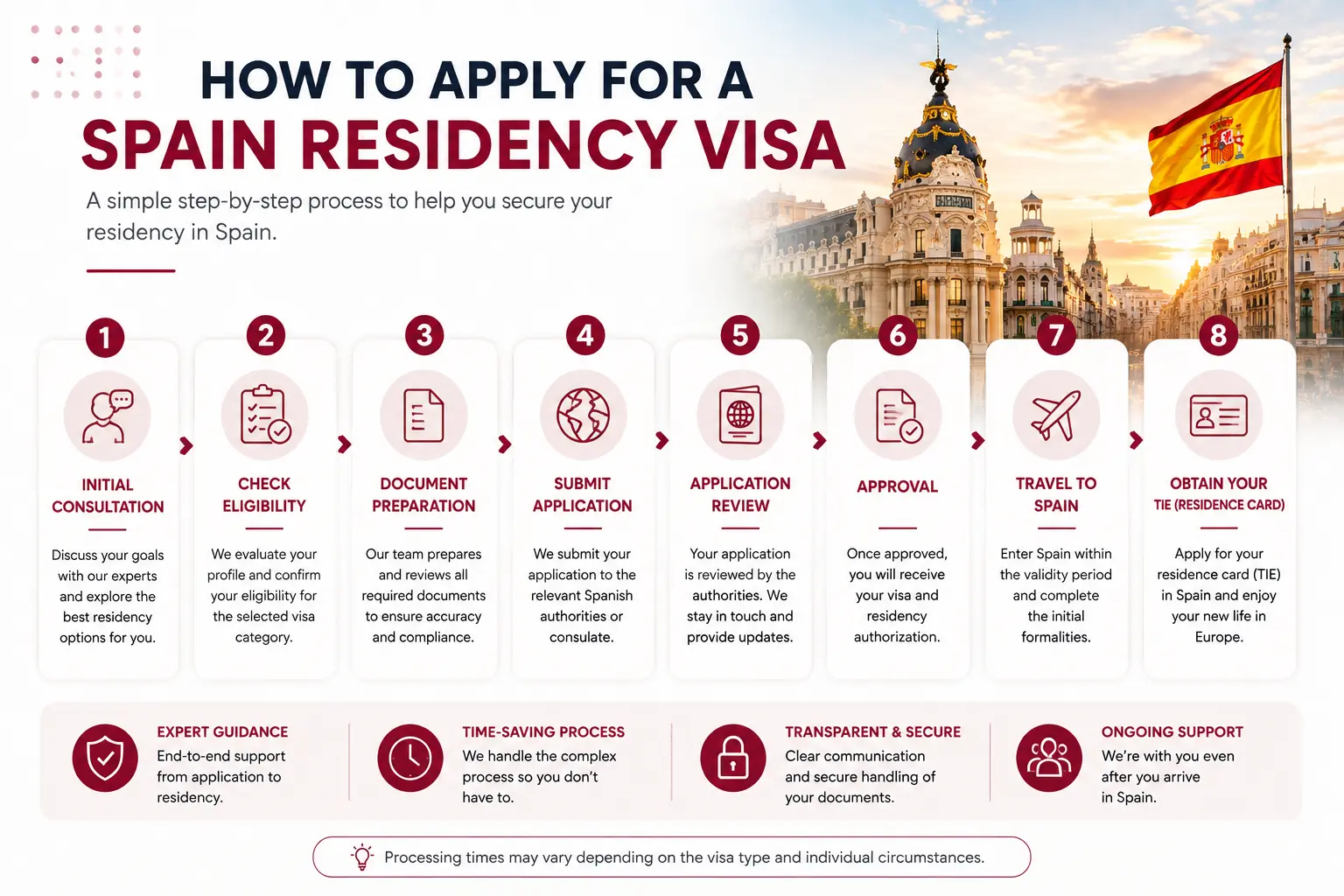
- Confirm which visa category matches your situation — this is the single most important decision, since applying under the wrong category (for example, submitting freelance income as if it were passive NLV income) is one of the most common causes of delay or rejection.
- Run a financial and eligibility check against the specific thresholds for your chosen visa — income, salary, or business plan requirements, plus family composition if dependents are included.
- Collect and legalize your documents — passport, criminal record certificates, medical certificate, proof of income or employment, and health insurance. Every non-Spanish document typically needs an apostille and a certified Spanish translation; documents older than three months are often rejected outright, so timing matters.
- Submit your application at the Spanish consulate covering your place of residence — for UAE-based applicants, this generally means the Spanish Embassy or Consulate in the UAE, though appointment availability can vary and often needs to be booked well in advance.
- Attend your consular appointment, including biometric data collection where required.
- Wait for a decision — typically one to three months for the NLV and DNV, and often within about ten days for the PAC visa once submitted through the UGE-CE.
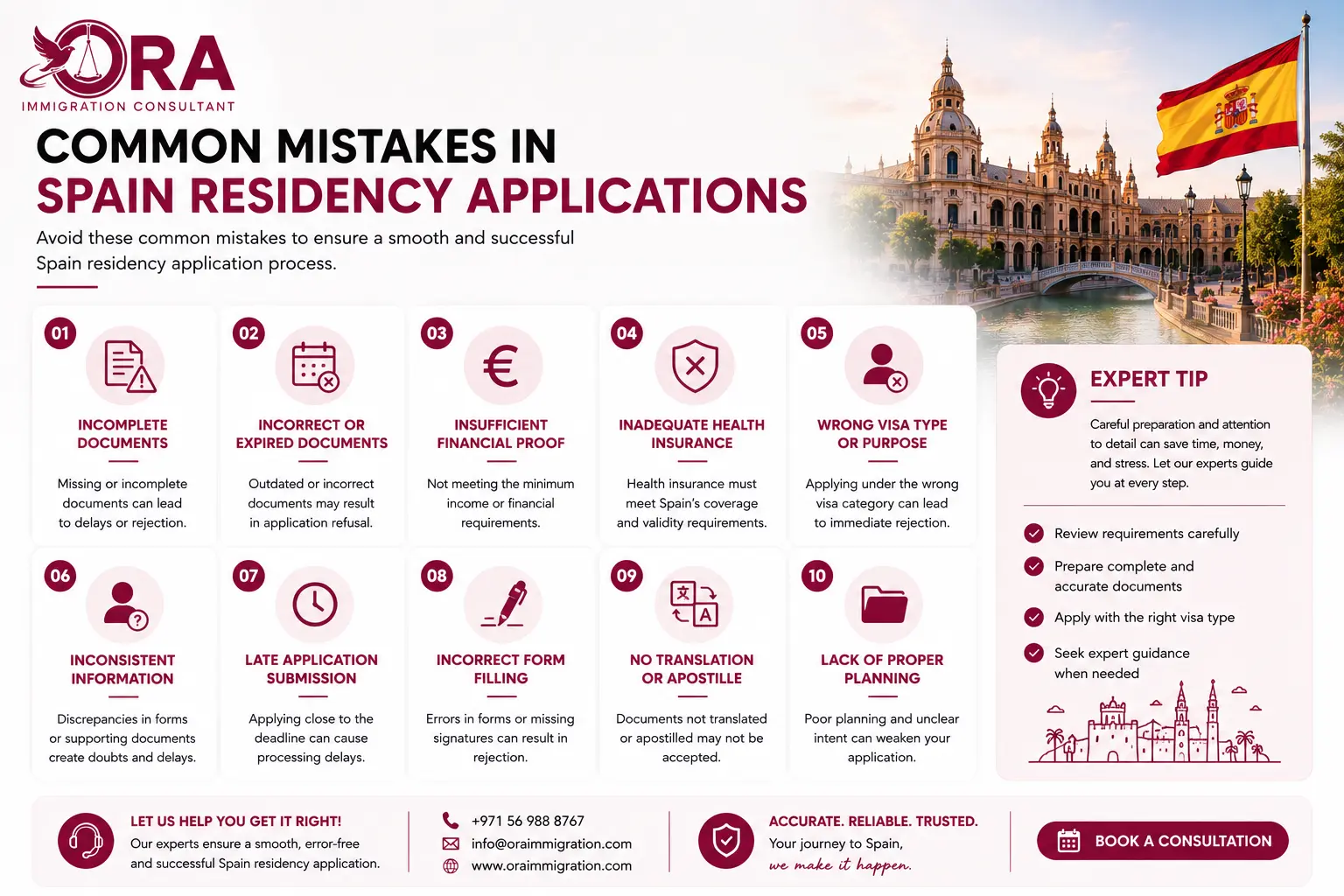
- Travel to Spain and complete local registration, including applying for your TIE (foreigner identity card) within the required window after arrival, and registering your address with the local town hall (empadronamiento).
- Maintain ongoing compliance — this differs by visa: minimum physical presence for the NLV, income and Spanish-income-cap rules for the DNV, and employment continuity for the PAC visa. Falling out of compliance is the most common reason renewals get rejected, so it’s worth building this into your planning from day one rather than treating approval as the finish line.
Important: Approval is not the end of the process. Each residency route has ongoing compliance requirements, and these conditions should be considered before choosing a visa.
Documents typically required across Spain residency visas
While exact requirements vary by visa type and by which consulate processes your application, most Spain residency applications require some combination of:
- Valid passport with at least one year of remaining validity
- Recent passport-sized photographs meeting Spanish biometric standards
- Criminal record certificate from your country of residence and any country lived in over the past five years, apostilled and translated
- Medical certificate confirming you’re free of diseases with serious public health implications
- Proof of income, savings, or an employment contract, depending on visa type
- Comprehensive private health insurance valid in Spain, with no copayments
- Proof of accommodation in Spain — either ownership documents or a signed long-term lease
- Civil status documents for any dependents (marriage certificates, birth certificates), translated and legalized
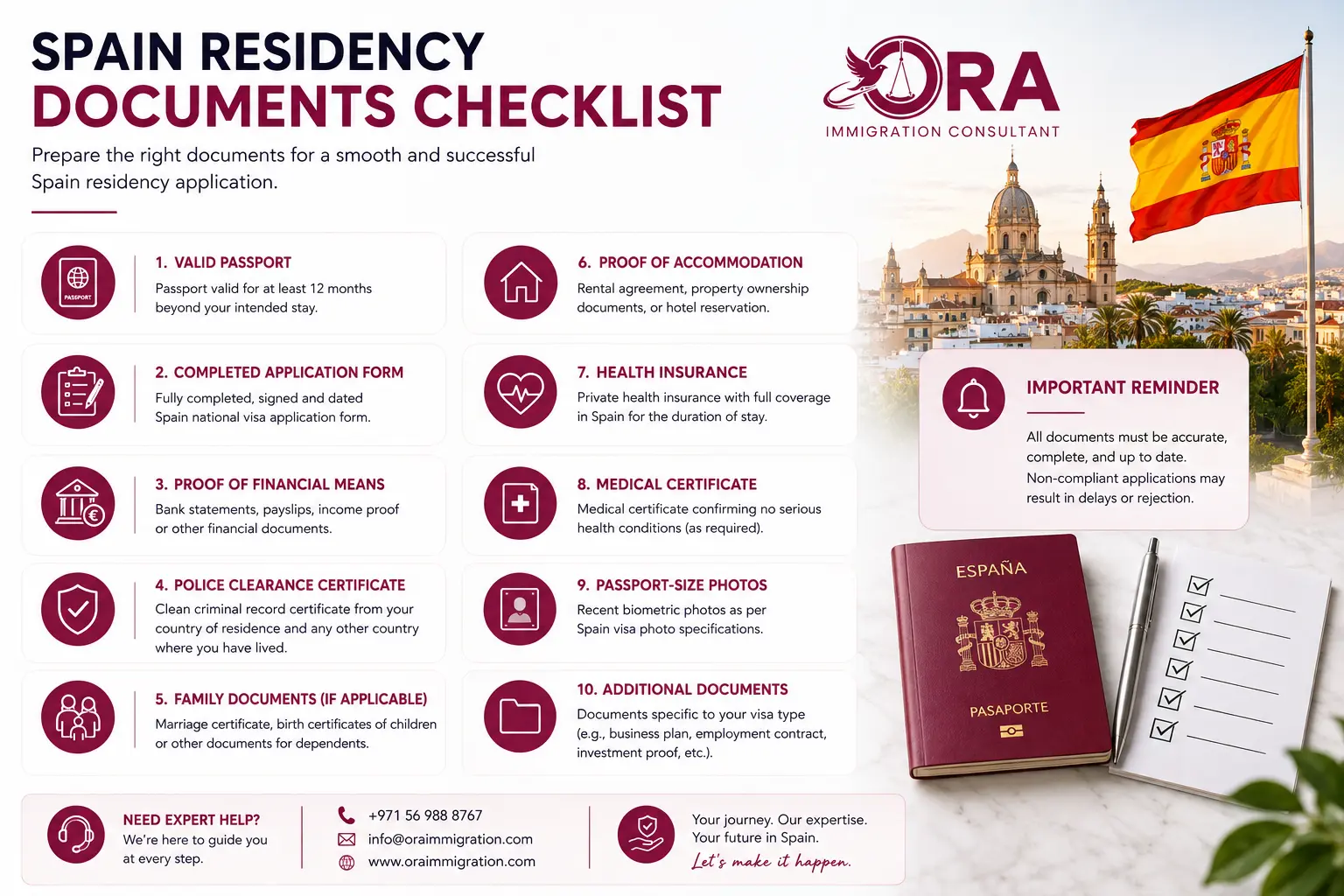
Ora Immigration provides a personalized checklist during your assessment, since the exact combination and formatting requirements can shift slightly depending on which Spanish consulate handles your file.
Costs and timelines: what to actually expect
Application fees for Spanish national visas are relatively modest compared to the investment thresholds under the old Golden Visa. The visa fee itself is typically in the range of a few hundred euros per applicant, although total costs increase once document legalization, certified translations, health insurance, and any legal or consultancy support are included.
- Non-Lucrative Visa: generally 1–3 months
- Digital Nomad Visa: generally 1–3 months
- Highly Qualified Professional Visa: often around 10 days through the UGE-CE fast-track process
Post-Arrival Costs and Steps
Applicants should also budget for post-arrival steps in Spain, including TIE card issuance, local registration, and, where relevant, Social Security enrollment. These additional steps can take several weeks before the process feels fully complete.
Common mistakes to avoid when applying
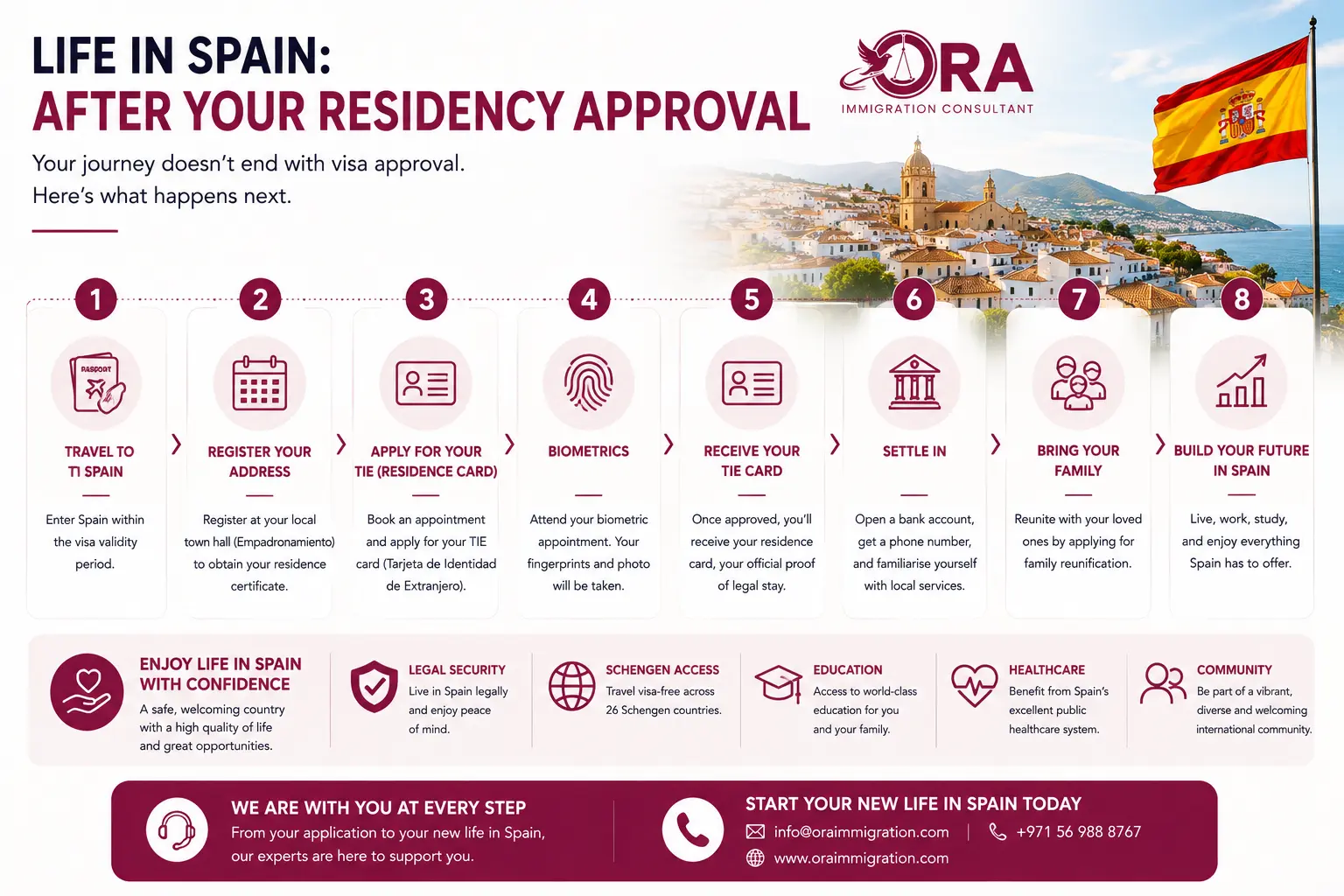
- Assuming the Golden Visa is still available. This remains the single most common and costly misconception — some applicants spend months structuring a property purchase around a program that no longer accepts new applicants.
- Applying under the wrong visa category. Passive versus active income is the dividing line between the NLV and DNV, and consulates check this closely.
- Submitting expired documents. Criminal record certificates and medical certificates are typically only valid for three months from issuance — a delay anywhere in the process can push a document past its validity window.
- Buying inadequate health insurance. Travel insurance, policies with high copayments, or policies excluding coverage within Spain are a frequent cause of rejection.
- Underestimating the 183-day presence rule on the NLV, especially for applicants used to the Golden Visa’s no-stay-requirement structure.
- Skipping certified translation and apostille steps, or using a translator not registered to work with Spanish authorities.
This depends heavily on visa type and how long you’ve lived in Spain. Digital Nomad Visa and Highly Skilled Professional Visa holders may qualify for the Beckham Law regime, taxed at a flat 24% on income up to €600,000 for up to six years. Standard Spanish tax residents are taxed on worldwide income at progressive rates up to 47%. Given the UAE’s zero personal income tax environment, this is one of the most important financial factors to model carefully before relocating — and it’s worth getting professional tax advice specific to your situation.
Yes, across all major routes. Spouses or registered partners, dependent children, and in many cases dependent parents can apply alongside the main applicant, generally with an additional income requirement per dependent for the NLV and DNV, and family reunification built directly into the PAC visa process.
Ten years of continuous legal residency under any qualifying visa, followed by passing the DELE A2 Spanish language exam and the CCSE exam on Spanish culture and constitutional knowledge. Investment amount has no effect on this timeline — it applies equally regardless of visa type or financial profile.
No. None of the currently active residency routes — NLV, DNV, PAC, or Entrepreneur Visa — require a property purchase. Property ownership can support your accommodation requirement for certain visas, but it isn’t itself a qualifying investment anymore.
The Highly Qualified Professional Visa is typically the quickest, often processed within about ten days through Spain’s dedicated UGE-CE fast-track unit, since it requires an employer sponsor and a defined role. The NLV and DNV usually take one to three months.
The core difference is whether your income is active or passive. The NLV is for people living on pensions, investments, or savings who won’t work at all in Spain. The DNV is for people actively earning a living remotely, whether employed or freelance, for employers or clients based outside Spain.
Yes, through the Digital Nomad Visa, provided you earn at least approximately €2,850 per month from an employer or clients based outside Spain, and no more than 20% of your income comes from Spanish sources.
Applications are submitted through the Spanish consulate covering the UAE, with full supporting documentation — proof of income or employment, health insurance, criminal record certificates, and accommodation proof. Most applicants also need an in-person consular appointment. Ora Immigration manages this process end-to-end for UAE-based applicants, from eligibility assessment through document preparation and submission.
The Non-Lucrative Visa is built for exactly this situation — it requires proof of at least €2,400 per month in passive income for the main applicant, plus comprehensive health insurance and proof of accommodation, but no employment or business activity in Spain.
No single program replaced it. Applicants who previously would have used the Golden Visa now typically choose between the Non-Lucrative Visa (passive income), the Digital Nomad Visa (active remote income), the Highly Skilled Professional Visa (confirmed job offer), or the Entrepreneur Visa (genuine business project).
Yes, for new applicants. Existing Golden Visa holders can continue renewing their permits under the program’s original rules, but no new applications have been accepted since the April 2025 cutoff, and there’s no announced plan to reopen it.
No. Spain has never had a direct citizenship-by-investment program. Its former Golden Visa granted residency, not citizenship, and that residency-by-investment route was discontinued on 3 April 2025.
Why Work With Ora Immigration for Your Move to Spain?
Spanish immigration law changed substantially in 2025, and a meaningful amount of content still circulating online — including from other consultancies — hasn't caught up with it. Ora Immigration's advisors track the current Spanish immigration framework directly, so UAE and GCC applicants get an accurate eligibility assessment from the first conversation, rather than time spent pursuing a route that no longer exists. We handle everything from initial eligibility review through document preparation, translation coordination, consular submission, and post-arrival guidance in Spain.