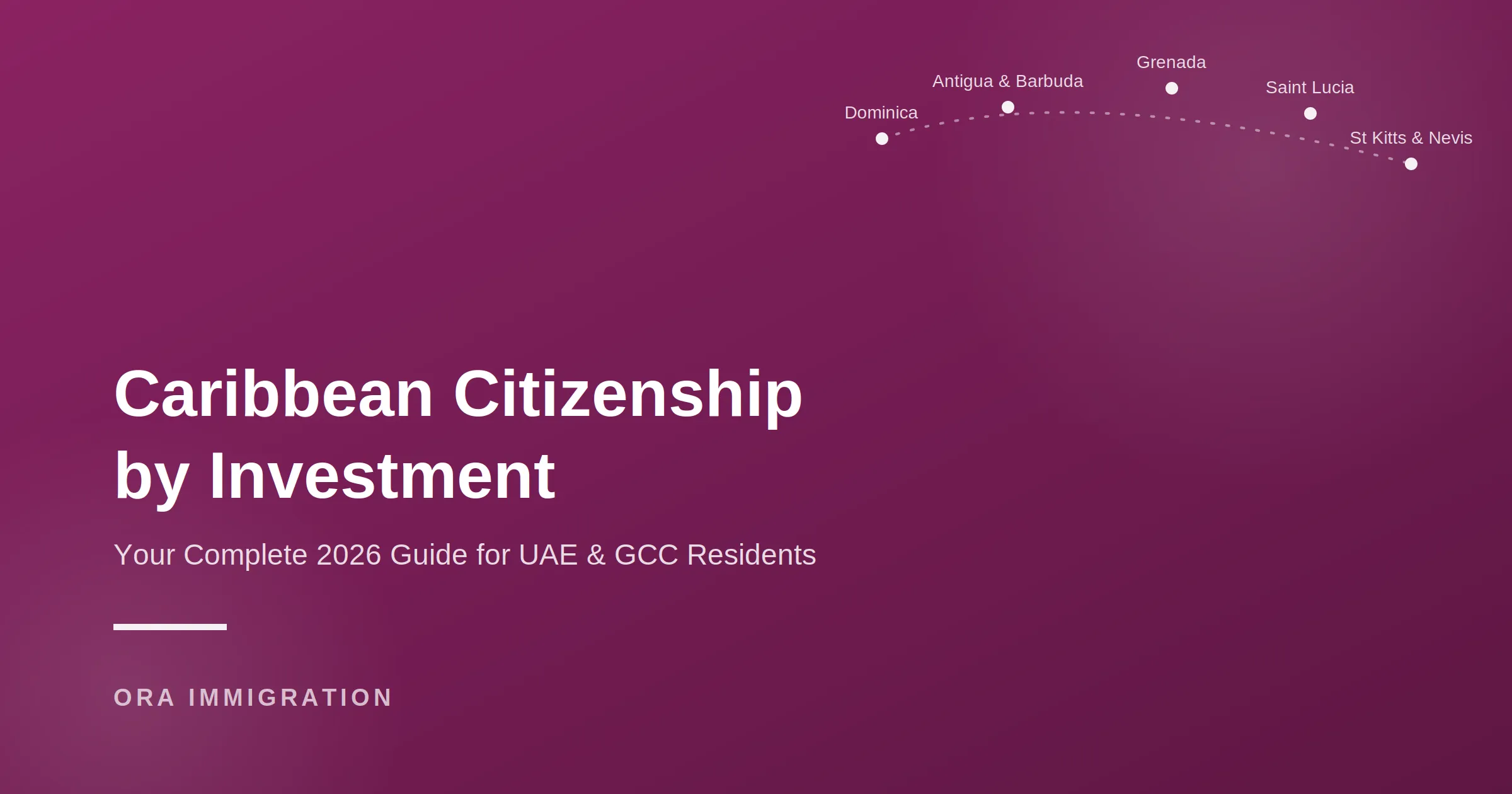
Ask anyone about second passports and the Caribbean comes up fast. For UAE and GCC residents, it’s often the quickest way in. Five countries run official programs: Dominica, Antigua & Barbuda, Grenada, Saint Lucia, and St Kitts & Nevis. Each one grants full citizenship, not a temporary card. And none of them ask you to move there.
So how does it actually work? Why does “Saint Lucia investment citizenship” get searched so much on its own? And what does the process look like if you’re applying from Dubai, Abu Dhabi, Riyadh, or anywhere else in the Gulf? That’s what this guide walks through.
What Is Caribbean Citizenship by Investment?
CBI stands for citizenship by investment. You invest in a country. In return, you get citizenship. That’s the whole idea.
This isn’t a loophole. Each of the five countries has it written into law. Each one runs a government unit that handles these applications. St Kitts & Nevis started it in 1984 — the first modern CBI program anywhere. The industry’s been around for over forty years now.
“Buy Caribbean citizenship” and “buy a Caribbean passport” get searched constantly, and fair enough, but the phrasing’s a little off. Nobody hands over cash and walks out with a passport that same day. The government reviews the application first, runs due diligence and background checks, and only approves it once that’s done. Even so, the end result lands pretty close to what people mean by “buy” — a second nationality through investment instead of years spent actually living somewhere.
Why UAE and GCC Residents Choose Caribbean Citizenship
A Gulf residence visa only takes you so far. A Caribbean passport fills some real gaps:
- Visa-free or visa-on-arrival access to 140+ countries, including the UK, Schengen Europe, Singapore, and Hong Kong. Most GCC visas don’t open these doors.
- No residency requirement on several programs. You may never need to visit the island.
- Full citizenship, not a renewable permit. It lasts for life, and your children inherit it too.
- Speed. Most other naturalization routes take five to ten years. This one takes months.
- Room for family. Spouses, children, and often parents and siblings can join, depending on the program.
Most Gulf-based investors aren’t planning to relocate. Think of it more like insurance. It sits alongside UAE residence status rather than replacing it.
→ Book a Free Consultation to Discuss Your Options
The Five Caribbean Citizenship Programs
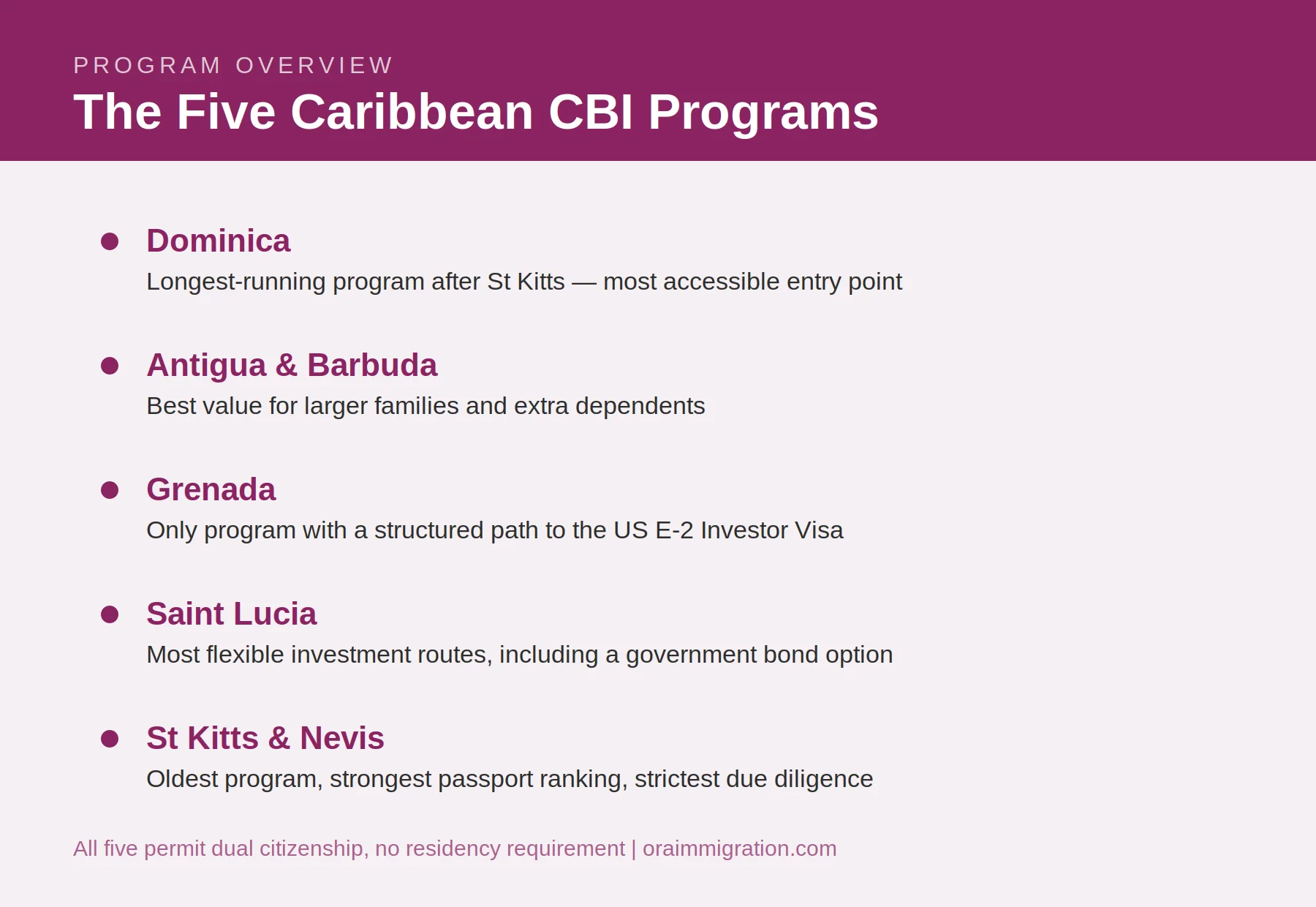
All five programs now share a minimum investment floor. Regulators in the US and EU pushed for this between 2024 and 2026, aiming to tighten due diligence across the region. Past that shared floor, each program has its own strengths.
Only St Kitts has been running longer than Dominica, and most people still point to Dominica as the easiest of the five to qualify for.
Got a bigger family? Antigua & Barbuda tends to work out better financially, since its pricing covers more dependents before extra fees start piling on.
One thing sets Grenada apart: a clear path to the US E-2 Investor Visa. No other Caribbean program offers that, so if US business plans are part of your thinking, it’s worth a serious look.
Flexibility is where Saint Lucia wins. It runs some of the broadest investment routes in the region, bond option included — more on that just below.
As for St Kitts & Nevis, it’s the oldest of the five and carries the strongest passport ranking, but that comes with the toughest due diligence process going, mandatory biometrics and all as of 2026.
We won’t print exact figures here. They shift. Family size changes them. Nationality changes them. The programs themselves get revised too. Talk to our team, and we’ll walk you through current numbers for your situation.
→ Compare Programs With Our Team
Saint Lucia Investment Citizenship: A Closer Look
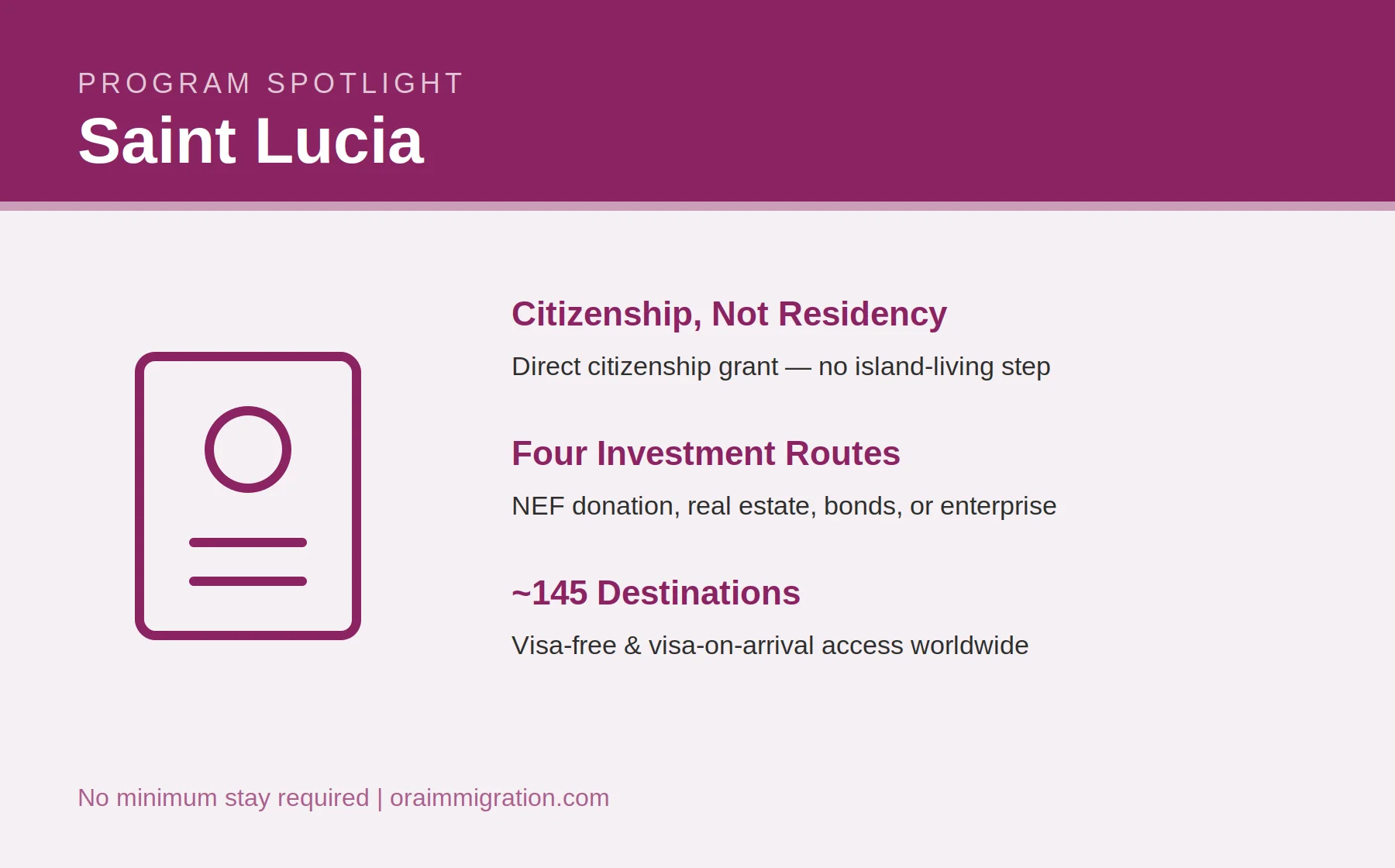
“Saint Lucia investment citizenship” and “St Lucia residency by investment” show up in search constantly. So this one gets its own section.
First, a quick fix for a common mix-up: Saint Lucia’s CBI program grants citizenship directly. It isn’t a residency track that later turns into citizenship. There’s no island-living requirement in between. You apply, you get approved, you’re a citizen. That’s likely why people search “residency by investment” for Saint Lucia. They assume there’s a residency step. There isn’t one.
The program runs through the National Economic Fund and offers a few paths in:
- A straight donation to the NEF, with the amount set by family size
- Approved real estate, held for a set number of years before resale
- A government bond option. It’s less common, but it appeals to people who want some return rather than a pure donation.
- Enterprise investment, putting money into an approved business project
A Saint Lucia passport opens visa-free or visa-on-arrival access to roughly 145 destinations. And like the other four programs, nobody checks whether you ever visit the island once citizenship is granted.
→ Check Your Eligibility for Saint Lucia Citizenship
How Much Does Caribbean Citizenship Actually Cost?
Two things drive the cost: how many people are applying, and what passport you hold now.
Family size matters first. Most programs set a base price that covers a single applicant or a family of up to four. Add a fifth person, or a parent, or a sibling, and each one adds its own fee. A family of five pays more than a single applicant, obviously, but the gap often runs bigger than people expect.
Nationality matters too, and this one surprises people more. Due diligence fees, processing costs, and sometimes even the base contribution can shift depending on your current passport. Some nationalities need more verification work on the government’s end, and that shows up in the final cost.
So there’s no single number we can give you here that would actually mean anything. Thresholds change. Family situations vary. Nationalities vary. The best move is a direct conversation with our team. We’ll pull current figures for your actual situation instead of handing you a number that might already be outdated.
→ Get Your Personalized Cost Estimate
How Long Does It Take to Get Caribbean Citizenship?
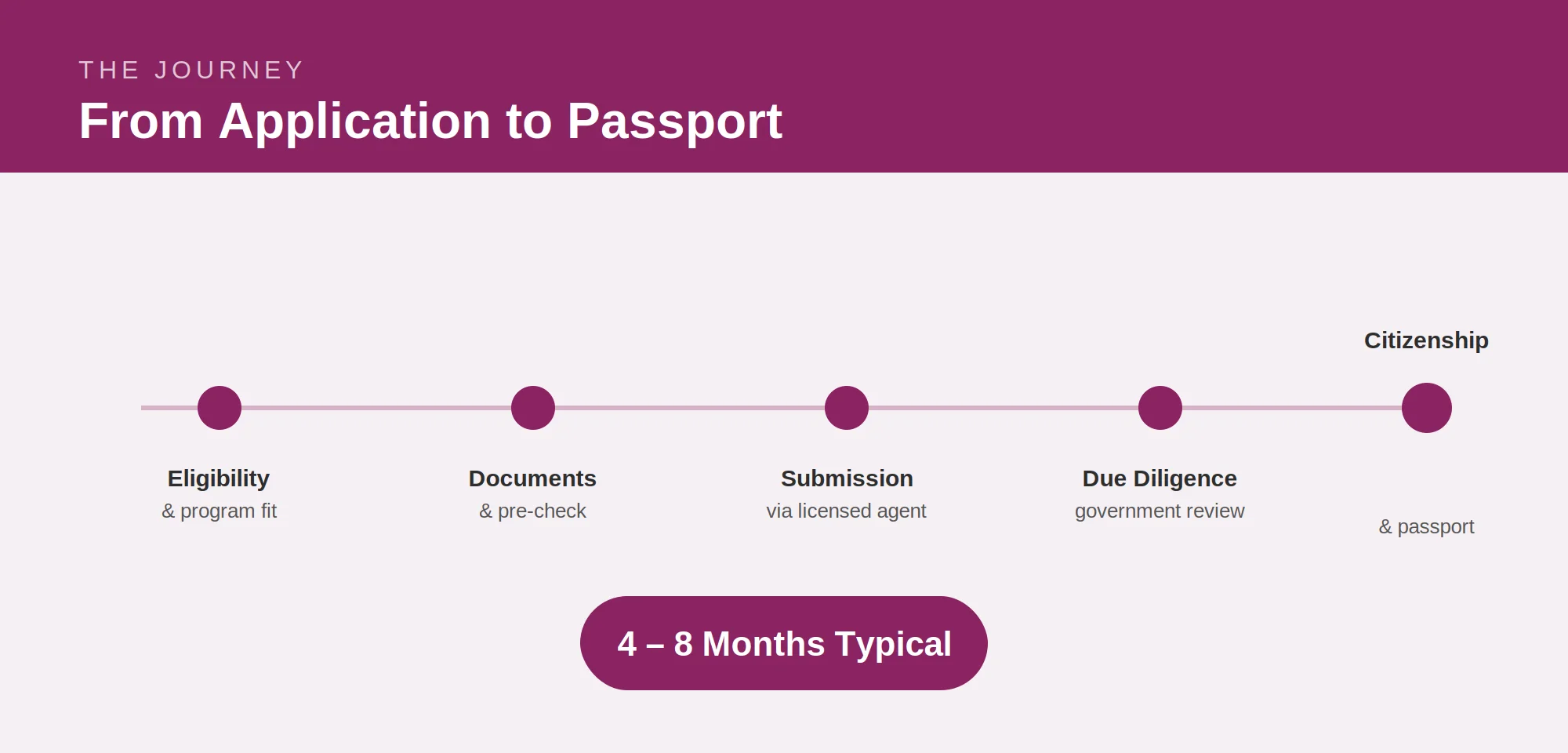
Most applications take four to eight months, start to finish. Three things decide where you land in that range: the program you pick, how fast you submit documents, and whether due diligence flags anything for a closer look. Clean applications move faster, same as most government processes anywhere.
Either way, compare that to five or ten years for standard naturalization elsewhere. It’s not close.
The Application Process
Paperwork varies a bit by program, but the general shape stays the same:
- First, we go over your profile, your family, and your goals, and recommend the program that actually fits.
- Next comes document collection — passports, police clearances, proof of funds — plus an informal risk check before anything gets submitted.
- The application then goes in through a government-licensed agent. There’s no applying directly; it has to run through an authorized channel.
- From there, the government’s Citizenship by Investment Unit runs its background checks, sometimes alongside outside due diligence firms.
- Approval in principle comes next.
- Then you complete the investment, whether that’s the donation or the real estate purchase.
- Last step: citizenship gets granted, and your passport gets issued.
Documents You’ll Typically Need
Every applicant needs a passport, for starters. Add birth certificates, marriage certificates if they apply, and police clearance from everywhere you’ve lived long-term — apostilled or attested. Then there’s proof of funds, usually bank statements, a medical certificate (most programs require one), passport photos, and often a CV or written summary of your professional background.
For UAE and GCC-based applicants, attestation is usually the slow part. You’ll need to legalize documents through the Ministry of Foreign Affairs, then again through the receiving country’s process. Start this step early. It’s the one most likely to stretch out your timeline if you leave it for later.
Common Mistakes and Misconceptions
Thinking you’re literally buying a passport with no questions asked is a big one. Not true. Real vetting happens, and applications do get rejected when due diligence raises concerns.
Then there’s the assumption that all five programs cost the same. They don’t. For a larger family, the gap between the cheapest and most expensive option can add up fast.
Budgeting off a single-applicant figure trips people up too, especially once they remember they’re actually bringing a family of five. The number changes quickly once you add dependents.
Saint Lucia’s program gets mistaken for a residency-first route a lot. It’s not. Covered this above already, but it’s worth repeating since the mix-up is so common.
Unlicensed agents are another one. All five governments require applications to go through an authorized agent, and skipping that step, or using someone who isn’t licensed, causes real problems down the line.
Attestation timelines catch UAE and GCC applicants off guard more than anything else on this list. That step, not government processing, is usually the actual bottleneck.
Important Disclaimer
The information on this page is provided for general informational purposes only and should not be considered legal or immigration advice. Immigration laws, eligibility requirements, fees, and processing times may change without notice. Applicants should always verify the latest requirements with the relevant authorities or seek professional guidance before making any immigration decisions.
Citizenship alone doesn’t usually make you a tax resident there. Tax depends on where you actually live and earn, and on your home country’s rules. We aren’t tax advisers, so check with one before you apply.
You don’t make the main investment until approval in principle comes through. Government and due diligence fees may not be refundable, though, and the rules differ by program. Ask about refunds before you commit. A serious criminal record or unexplained source of funds is the most common reason for rejection.
Not usually. A licensed agent handles most of the process. Some programs do ask for biometrics or an interview, and the rules differ by country, so we’ll tell you upfront what yours needs.
The UK and Schengen Europe are visa-free for most of these passports. The US generally still requires a visa. Grenada’s E-2 route is a separate path for investors with US business plans.
In most cases, no. Your UAE residence stays tied to your original passport and carries on as before. A Caribbean passport adds a nationality. It doesn’t replace your life in the UAE.
That depends on your home country’s own laws. Some Gulf countries restrict it. Check your country’s rules before you apply, and talk to us if you’re unsure.
Both can. What matters is the passport you hold, not where you live. Some nationalities face extra checks, and a few are excluded by individual programs, so it’s worth confirming yours early.
Yes. Each of the five countries runs its program under its own law, through a government unit. It’s a regulated process, and applications get vetted before approval.
Yes. Spouses and children are standard across all five programs. Most also allow parents and siblings, usually for an extra fee once you’re past the base family size each program covers.
Usually four to eight months, from a complete application to passport in hand.
Citizenship, granted directly. There’s no separate residency phase.
No. None of the five programs require residency, before or after citizenship is granted.
It depends on your family size and nationality. There’s no single answer that fits everyone. Talk to us, and we’ll compare all five programs against your actual situation.
Not in the sense of handing over money with no scrutiny. There’s a real government vetting process, and rejections happen. But the practical outcome matches what most people mean: a second nationality gained through investment rather than years of residency.