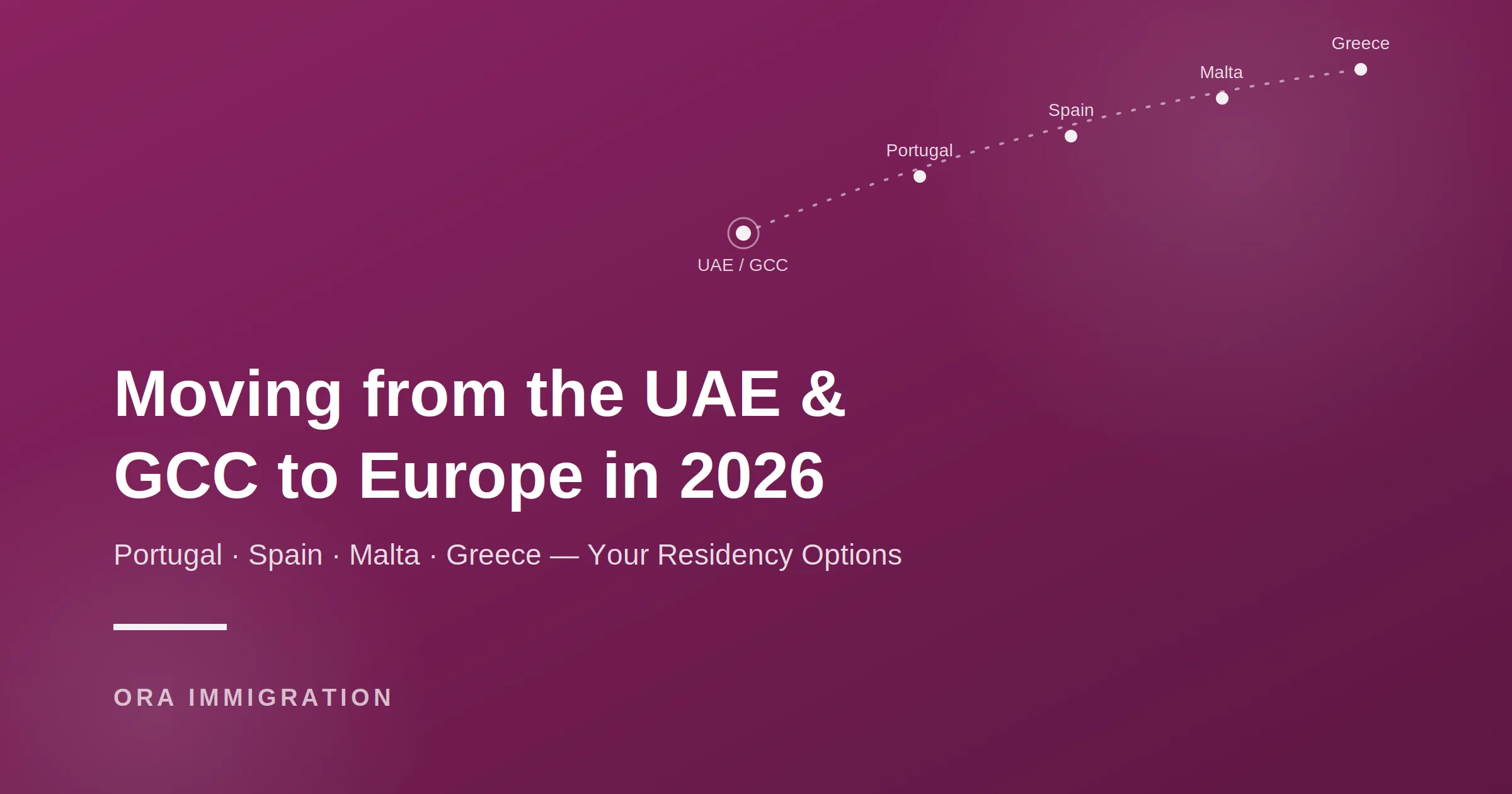
More people across the UAE, Saudi Arabia, Qatar, Kuwait, Bahrain, and Oman are asking the same question these days: is it worth getting a European residency? It’s not idle curiosity anymore. Remote work has made relocation easier, mobility trends are shifting, and a growing number of GCC-based professionals (Gulf nationals and the region’s large expat population alike) are looking for a second base in Europe. 2026 has turned into a genuinely active year for this kind of planning.
The hard part isn’t deciding you want a European residency. It’s working out which one suits your situation. Portugal, Spain, Malta and Greece all run several programmes at once, and the requirements, costs and timelines differ a lot depending on whether you’re retiring, working remotely, running a business, or investing. This guide covers what’s actually open to UAE and GCC residents right now, including the region’s large expat community, without dressing it up.
Why UAE and GCC Residents Are Exploring European Residency
Gulf residency systems do their job well, but there’s a ceiling to what they offer. Residence visas across the UAE, Saudi Arabia, Qatar and the wider GCC are tied almost entirely to employment, property ownership, or running a business. Millions of expats build their lives here under that arrangement, and it stays temporary by design. It doesn’t lead to citizenship. Even for Gulf nationals, it doesn’t open up the right to live and work freely across dozens of other countries.
A European residency fills that gap. Here’s roughly what it offers:
- Visa-free movement across the Schengen Area’s 29 countries, instead of applying each time
- A route toward permanent residency and, eventually, citizenship – something most Gulf systems simply don’t offer, no matter how many years you’ve lived there
- Access to EU healthcare and education systems for your family
- A legal foothold outside the Gulf that works as a genuine backup plan, whether that’s for business, your kids’ university options, or just lifestyle
- Tax planning that can work in your favour, depending on the programme
For a lot of professionals, business owners and investors across Dubai, Abu Dhabi, Riyadh and Doha, this isn’t really about leaving the Gulf at all. It’s about having an option they currently don’t – which matters most for expats whose entire legal standing in the region depends on staying employed or sponsored.
European Residency vs. a Schengen Tourist Visa
Worth clearing this up early, because people mix the two up constantly. A Schengen tourist visa lets most GCC-based travellers enter Europe visa-free, or on a short-stay basis, for up to 90 days in any 180-day period. Fine for a holiday. But it gives you no right to work, no route to permanent status, and no protection if entry rules get stricter down the line.
A residency permit works differently. It lets you legally live in the country – and often work or run a business there – for an extended stretch, usually one to five years to start, renewable after that. Time spent on it generally counts toward permanent residency and citizenship. Stamps in your passport from tourist trips never will.
If what you actually want is a real second base rather than more frequent holidays, you need a residency pathway. Not another round of Schengen entries.
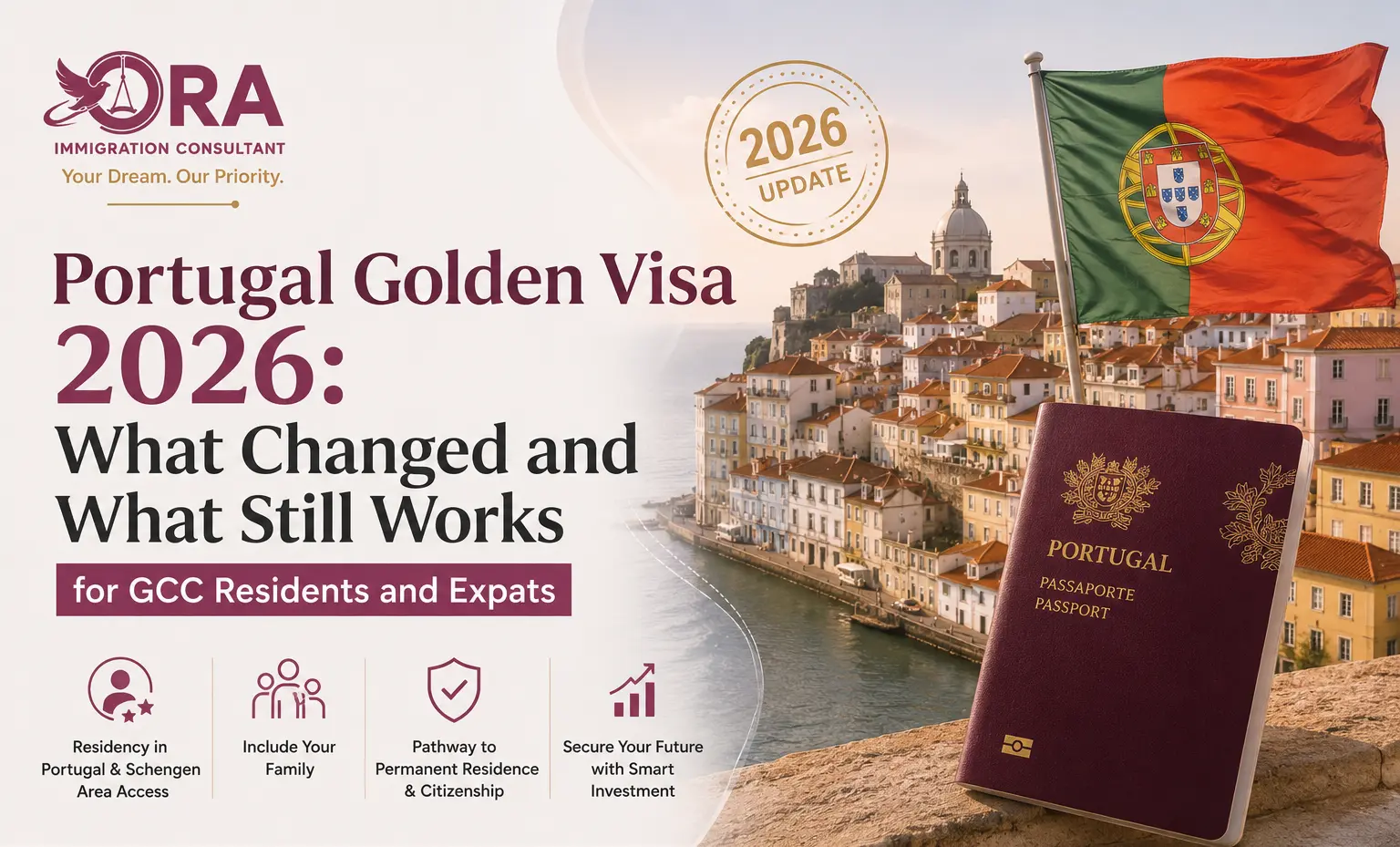
Portugal Residency Options
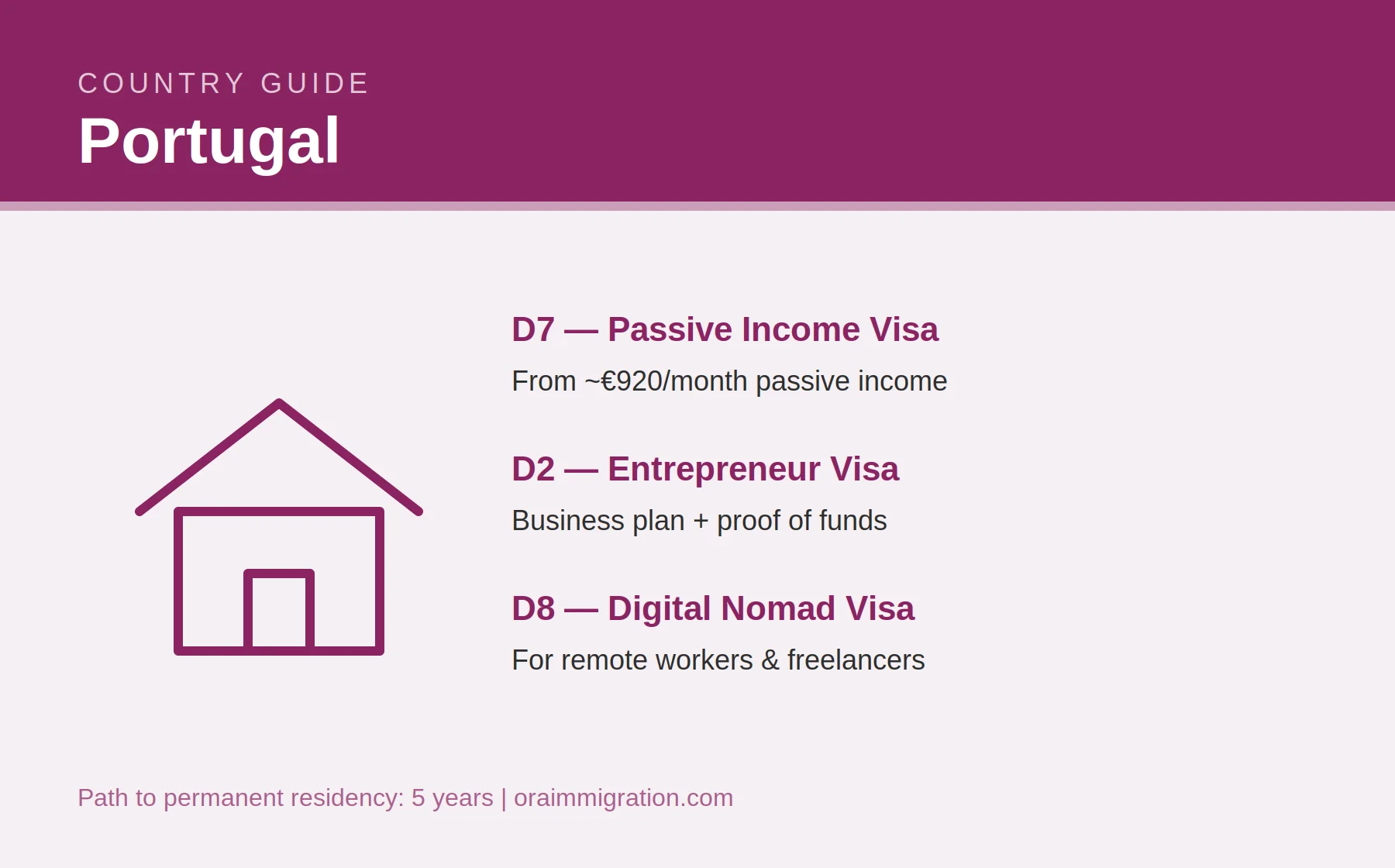
Portugal stays one of the most popular choices for people relocating from the UAE and the wider GCC. Cost of living is lower than most of Western Europe, English gets you through daily life fine, and the visa categories are laid out clearly enough to plan around.
D7 Visa (Passive Income Visa). The go-to route for retirees, freelancers, and anyone living off pensions, rental income, dividends or investments. In 2026, that means showing passive income of roughly €920 a month – about €11,040 a year – with more required for each dependent.
D2 Visa (Entrepreneur Visa). Meant for people starting or moving a business to Portugal. There’s no fixed income threshold here, unlike the D7. Instead you need a credible business plan and proof of funds, commonly cited around €15,000, though it shifts case by case.
D8 Visa (Digital Nomad Visa). For remote employees and contractors earning from outside Portugal. The income bar moves each year alongside the D7 threshold, since both are tied to the minimum wage.
All three lead toward permanent residency after five years. Portugal remains one of the more accessible EU entry points, whether you’re a Gulf national or part of the region’s expat workforce.
Spain Residency Options
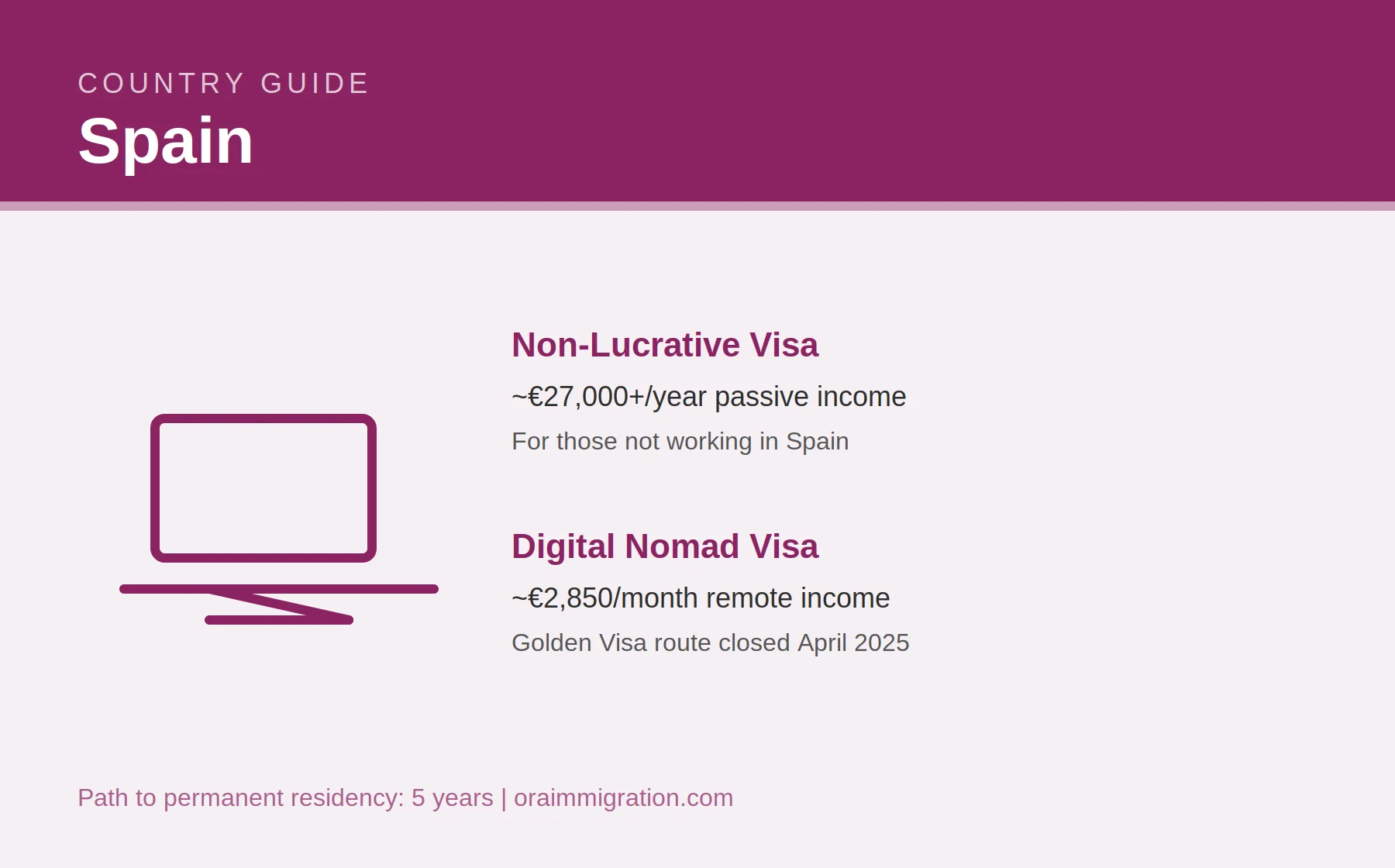
Spain’s residency picture changed after the Golden Visa – the real-estate investment route – shut down for good in April 2025. New applications under that scheme aren’t accepted anymore. What’s left, and still strong, are two non-investment routes.
Non-Lucrative Visa (NLV). For people who want to live in Spain without working there, usually retirees or anyone supported by savings or passive income. You’ll need to show financial means around €27,000+ a year as a single applicant, with more added per dependent.
Digital Nomad Visa. Built for remote employees and freelancers earning from clients or companies outside Spain. In 2026 the income minimum sits around €2,850 a month for a single applicant, calculated as 200% of Spain’s minimum wage. One thing to flag for anyone considering this route: you can no longer switch from a Non-Lucrative Visa to a Digital Nomad Visa while inside Spain. That conversion now has to happen from outside the country.
Malta Residency Options
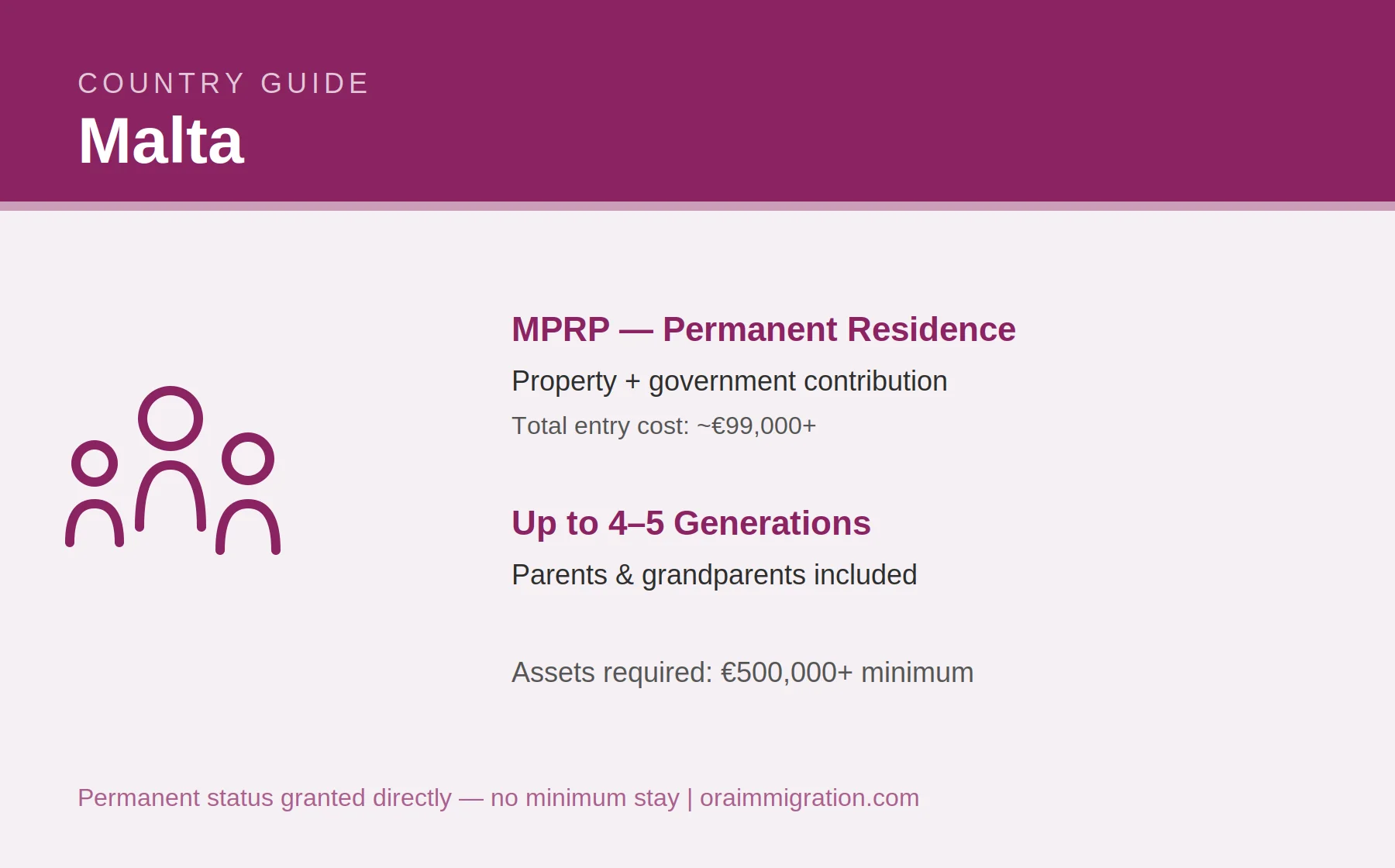
Malta suits Gulf-based applicants after an English-speaking EU base, particularly ones planning for extended family, not just a spouse and kids.
Malta Permanent Residence Programme (MPRP). Malta’s residency-by-investment scheme, restructured after amendments in 2025. As things stand in 2026, applicants need qualifying property in Malta – rent from around €14,000 a year, or a purchase starting near €375,000 – plus government contributions and fees that bring total entry costs to roughly €99,000 or more, plus a mandatory donation to a Maltese NGO. You’ll also need to show at least €500,000 in assets, with a set portion held as liquid funds.
The family structure is what really sets Malta apart. MPRP can cover up to four or five generations on a single application, parents and grandparents on both sides included.
Greece Residency Options
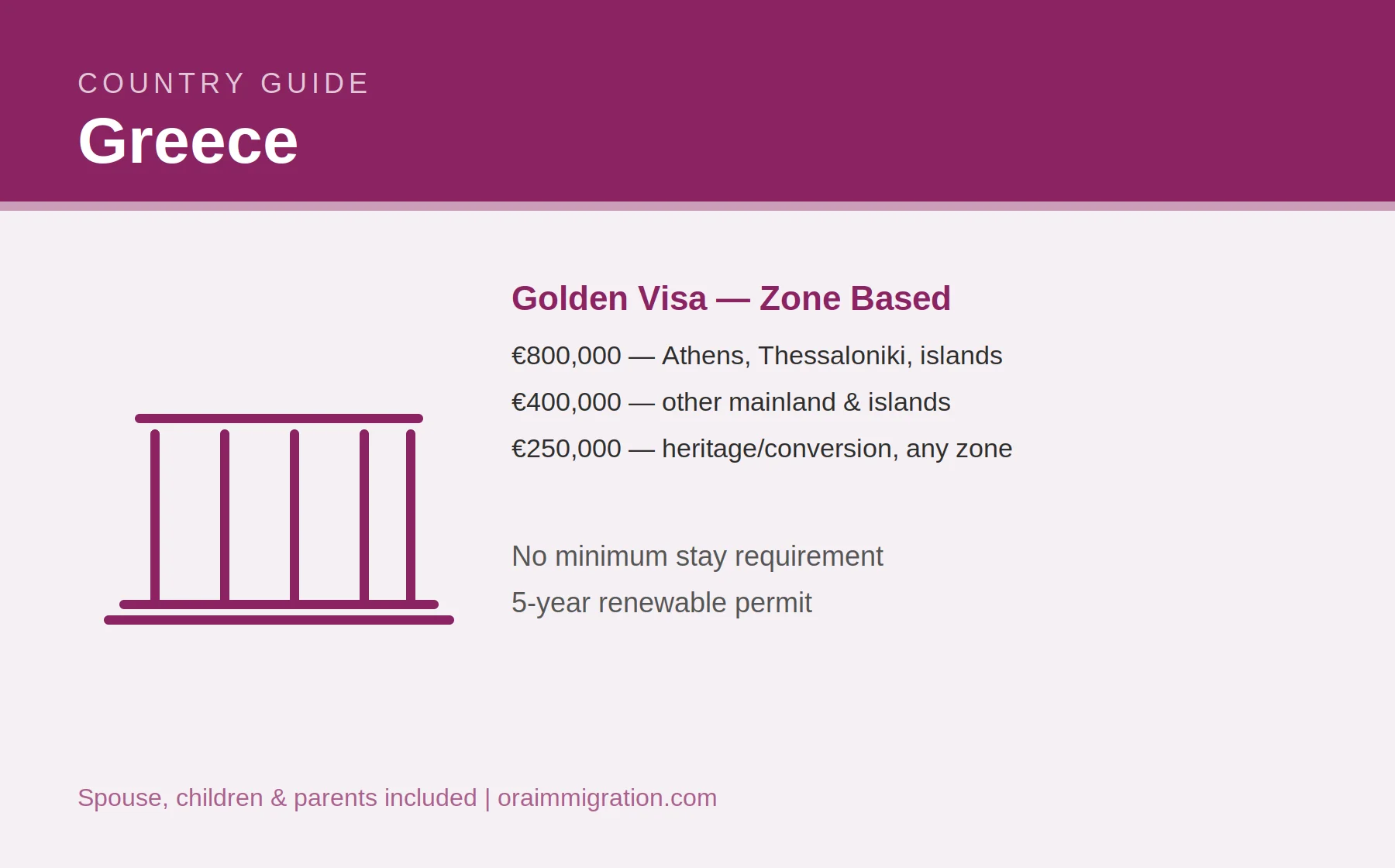
Greece’s Golden Visa is still one of the more accessible EU investment routes, though the rules got more location-dependent after changes introduced in 2024 that carried through into 2026.
The threshold now depends on where the property sits:
- €800,000 in high-demand areas: Athens (all of Attica), Thessaloniki, Mykonos, Santorini, and islands with over 3,100 residents
- €400,000 across most other mainland regions and smaller islands
- €250,000 specifically for converting commercial property to residential, or restoring listed heritage buildings – this one’s available regardless of location
There’s no minimum stay requirement to keep the Golden Visa active, which is part of why it appeals to GCC-based investors who want EU residency without moving there full-time. It runs as a five-year renewable permit and covers spouses, children, and parents on both sides at no extra investment.
Digital Nomad / Remote-Work Routes
If retirement or heavy investment isn’t the plan, the digital nomad category is often the most realistic way in – especially for the large number of remote-working expats already spread across the UAE and GCC. Portugal’s D8 and Spain’s Digital Nomad Visa work on the same basic logic: show your income comes from outside the country you’re moving to, meet the income floor, and demonstrate you’re not going to compete for local jobs.
These routes tend to be faster and cheaper to qualify for than the investment paths. The trade-off is that the status is usually a bit more limited on the settlement side until it converts into permanent residency.
Investment-Based Residency
For UAE and GCC residents with capital ready to deploy – and there’s a real number of Gulf nationals and established expat business owners in that position – investment-led “golden visa” style programmes are still live in Greece and Malta. Spain’s real-estate route is gone since 2025, and Portugal’s Golden Visa now leans mostly toward fund investments rather than direct property purchase.
The pitch is straightforward: no need to relocate right away, family included, and a direct route into Europe through capital rather than proving passive income or employment. The cost is higher up front than the passive-income or remote-work categories, and due diligence has gotten stricter across the board in 2026.
Trying to decide between Portugal, Spain and Malta specifically? Our Portugal vs Spain vs Malta comparison guide breaks down costs, timelines, and which one actually fits your profile.
Family Relocation Options
Almost every pathway above allows family to come along, but the fine print varies. Spouses are covered nearly everywhere. Dependent children are usually included up to 18, sometimes stretching to 21 or beyond if they’re still studying full-time. Parents, and in some cases grandparents, can be added under certain programmes – Malta’s MPRP goes furthest here, while Portugal and Spain stay more limited on extended family.
This tends to matter a lot for GCC-based expat families, many of whom currently have parents or in-laws living with them locally under Gulf residency rules that don’t offer the same long-term arrangement.
Getting Started: Documents and Application Basics
Whichever pathway you go with, most applications from this region ask for a similar core set of documents: a valid passport, proof of legal residence in your GCC country (Emirates ID, Saudi Iqama, Qatar ID or equivalent) if you’re an expat applicant, a police clearance certificate that’s been apostilled or attested, proof of income or funds, valid health insurance, proof of accommodation, and attested birth or marriage certificates for any dependents.
Applications generally go through the destination country’s consulate, embassy, or an authorised visa centre such as VFS Global, based in your country of residence. One thing worth knowing upfront: it’s your nationality, not your Gulf residence status, that usually sets your visa category and requirements. An Indian, Filipino, British or South African national living in Dubai applies based on their own passport, not their UAE residency – though a handful of nationalities need extra consular steps regardless of how long they’ve called the Gulf home.
Document attestation is usually what eats the most time in the whole process. Starting that early is one of the simplest ways to keep your timeline on track, no matter which country you’re heading to.
How to Choose a Pathway Based on Your Profile
- Retired or living off passive income? Portugal’s D7 or Spain’s Non-Lucrative Visa fit best.
- Building or moving a business to Europe? Portugal’s D2 is built for exactly that.
- Remote worker or freelancer with clients outside Europe? Compare Portugal’s D8 against Spain’s Digital Nomad Visa.
- Got significant capital and want a hands-off route with no obligation to relocate? Look at Greece’s Golden Visa or Malta’s MPRP.
- Want to bring extended family – parents, grandparents – under one application? Malta wins here by a clear margin.
- Working with a tighter budget but still want an EU foothold? Greece’s €250,000 heritage/conversion route is currently the cheapest investment path in Western Europe.
There’s no single right answer across the board. It comes down to matching the pathway to your actual finances, timeline and family setup, whatever your nationality or years in the region.
Common Mistakes UAE and GCC Residents Make
- Treating a Schengen visa as a stand-in for residency. It isn’t, and it offers no route to settlement.
- Underestimating attestation timelines. Documents often need MOFA attestation at home plus legalisation at the destination, and that can take weeks.
- Picking a country because it’s popular rather than because it fits. Portugal gets talked about the most, but a business owner is often better off with a D2 than chasing a passive-income route they don’t actually qualify for.
- Working from outdated thresholds. Income and investment figures move every year – Spain’s digital nomad minimum, Portugal’s D7 threshold, and Greece’s zone-based property minimums have all shifted during 2026. Applying with last year’s numbers is an easy way to get rejected.
- Trying to convert visa types from inside a country when that’s no longer allowed. Spain now requires certain conversions to happen from outside its borders.
- Assuming Gulf residency carries weight in the European application. It generally doesn’t. Nationality drives the requirements, not years spent in the UAE or GCC.
- Not planning past the five-year mark. Most permits are a stepping stone, and permanent residency or citizenship depends on keeping your status – and sometimes your physical presence – consistent over several years.
Usually, yes – after a set number of years of legal residence, typically five to ten depending on the country, as long as you keep meeting the ongoing requirements.
No. The real-estate investment route ended in April 2025. Spain’s Non-Lucrative Visa and Digital Nomad Visa are what’s left for non-investment applicants.
Both. Eligibility comes down to your actual passport, not your Gulf residency status, so the region’s large expat population can apply the same way Gulf nationals do, as long as they meet the destination country’s requirements.
No. The two are independent of each other, and plenty of people hold both at the same time.
Not sure which country or visa category fits your situation? Book a free consultation with Ora Immigration, and we’ll walk you through your options across Portugal, Spain, Malta, Greece, and beyond.
Immigration rules and financial thresholds change frequently — figures in this guide reflect 2026 requirements at the time of writing and should be confirmed with our team before you apply.