Two names come up again and again when UAE and GCC residents ask about a second passport: the Caribbean and Vanuatu. Both let you become a citizen through investment. Both skip the residency requirement. Past that, they’re quite different, and some of those differences have shifted a lot over the last two years.
So which one fits you? It depends on where you travel, who’s on the application, and how much risk you’re comfortable with. We’ll go through all of it, starting with the basics of holding more than one nationality.
What Is Dual Citizenship?
Dual citizenship means you hold two countries’ citizenship at the same time. You’ll also see it called dual nationality or double nationality, and multiple citizenship when it’s more than two. Same idea, different labels. Some people say dual passport, which is just the paper side of it, and a few forms use “dual national citizenship.” They all mean one thing.
Plenty of people want it. A second passport can make travel easier, give you a fallback if things change at home, and open doors for your kids’ schooling or your business. For many people in the Gulf, there’s another reason. A residence visa lasts only as long as the job or the sponsor does. A citizenship doesn’t.
Is Dual Citizenship Allowed? Check Your Home Country First
This is the step people skip. Some countries allow dual citizenship freely. Others restrict it, and a few take your citizenship away if you pick up another one voluntarily. India is a well-known example, since it doesn’t recognise dual citizenship. Several Gulf states also restrict it or ask for government permission, so GCC nationals especially need to check their own law first.
The rule that matters is your home country’s, not the Caribbean’s or Vanuatu’s. Both programs let you keep your current nationality. Whether your own government lets you is a separate question, and it’s the first thing we ask on a consultation. Unsure? Talk to a lawyer back home before you pay for anything.
How Do You Get a Second Passport?
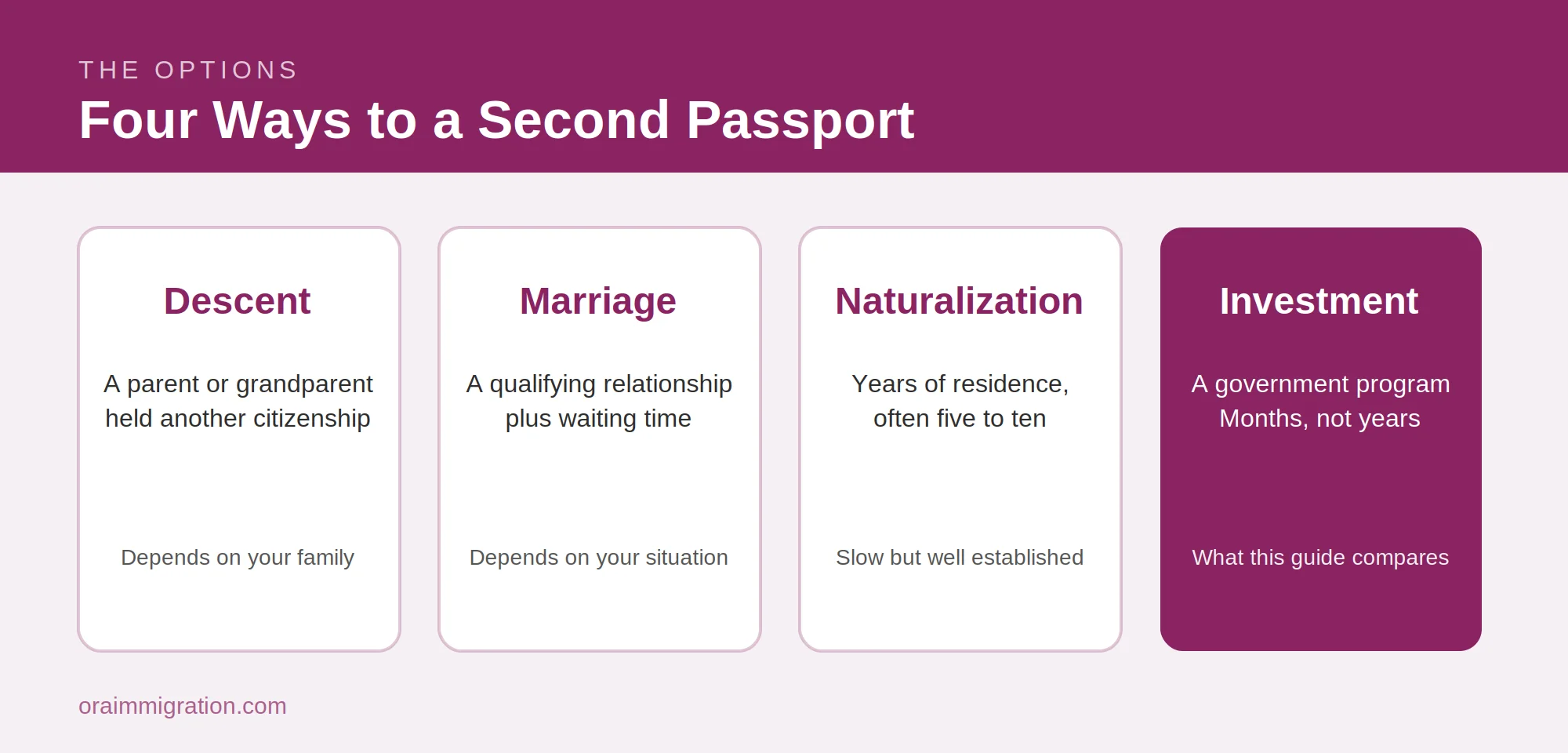
Most people end up on one of four roads. Descent works if a parent or grandparent held another country’s citizenship. Marriage can work too, with a qualifying relationship and some waiting time. Naturalization means living somewhere for years, often five to ten, and then applying. And then there’s investment.
Descent and marriage depend on your family story, and naturalization takes a long time. That leaves investment as the one route you can plan around today.
Second Passport by Investment: How It Works
Second citizenship by investment, usually shortened to CBI, is a government program. You put money into the country, pass due diligence, and become a citizen. No years of residence first. Two groups of countries dominate: five Caribbean islands (Dominica, Antigua & Barbuda, Grenada, Saint Lucia, and St Kitts & Nevis) and Vanuatu in the Pacific.
Every application goes through a licensed agent, and governments turn down applicants who don’t clear the background checks. It isn’t a shop counter. For the full picture on each, read our Caribbean citizenship by investment guide and our Vanuatu citizenship by investment guide.
Caribbean vs Vanuatu at a Glance
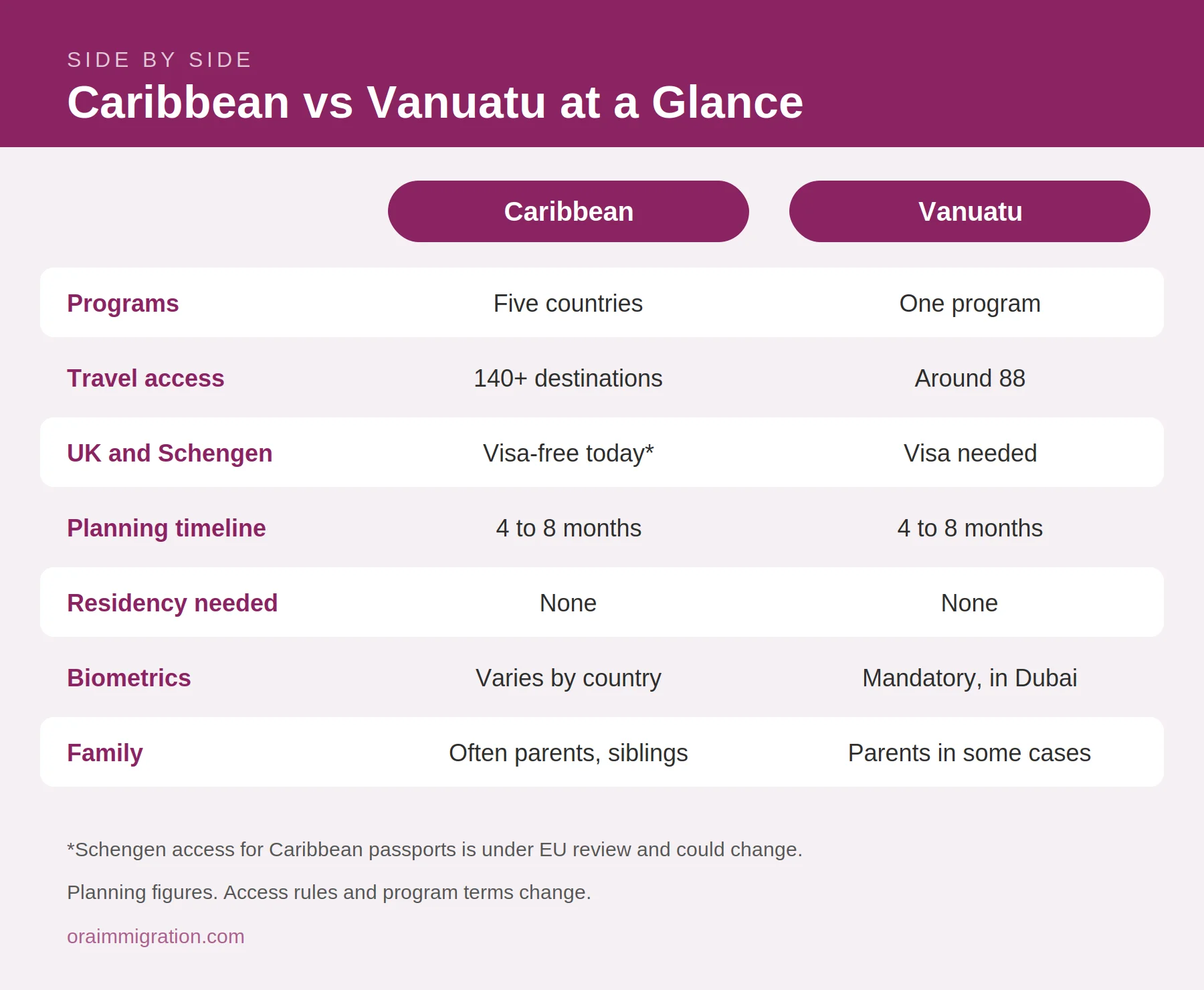
| Caribbean | Vanuatu | |
|---|---|---|
| Programs | Five countries, each with its own rules | One program |
| Travel access (2026) | 140+ destinations, including the UK and Schengen, but Schengen access is under EU pressure | Around 88 destinations; visa needed for the UK and Schengen |
| Residency requirement | None | None |
| Our planning timeline | 4 to 8 months | 4 to 8 months (government quotes 30 to 60 days) |
| Biometrics | Varies by country | Mandatory for everyone, taken in Dubai |
| Investment routes | Donation, real estate, bonds, enterprise (varies by country) | Contribution (DSP) or the hybrid CIIP |
| Family | Spouses, children, often parents and siblings | Spouse, children, and in some cases parents |
| Cost drivers | Family size and nationality | Family size and nationality |
| Main risk | Possible EU action on visa-free access | Already lost UK and EU access |
Access rules and program terms change. This table reflects 2026 as we write it.
Travel Access: The Difference That Matters Most
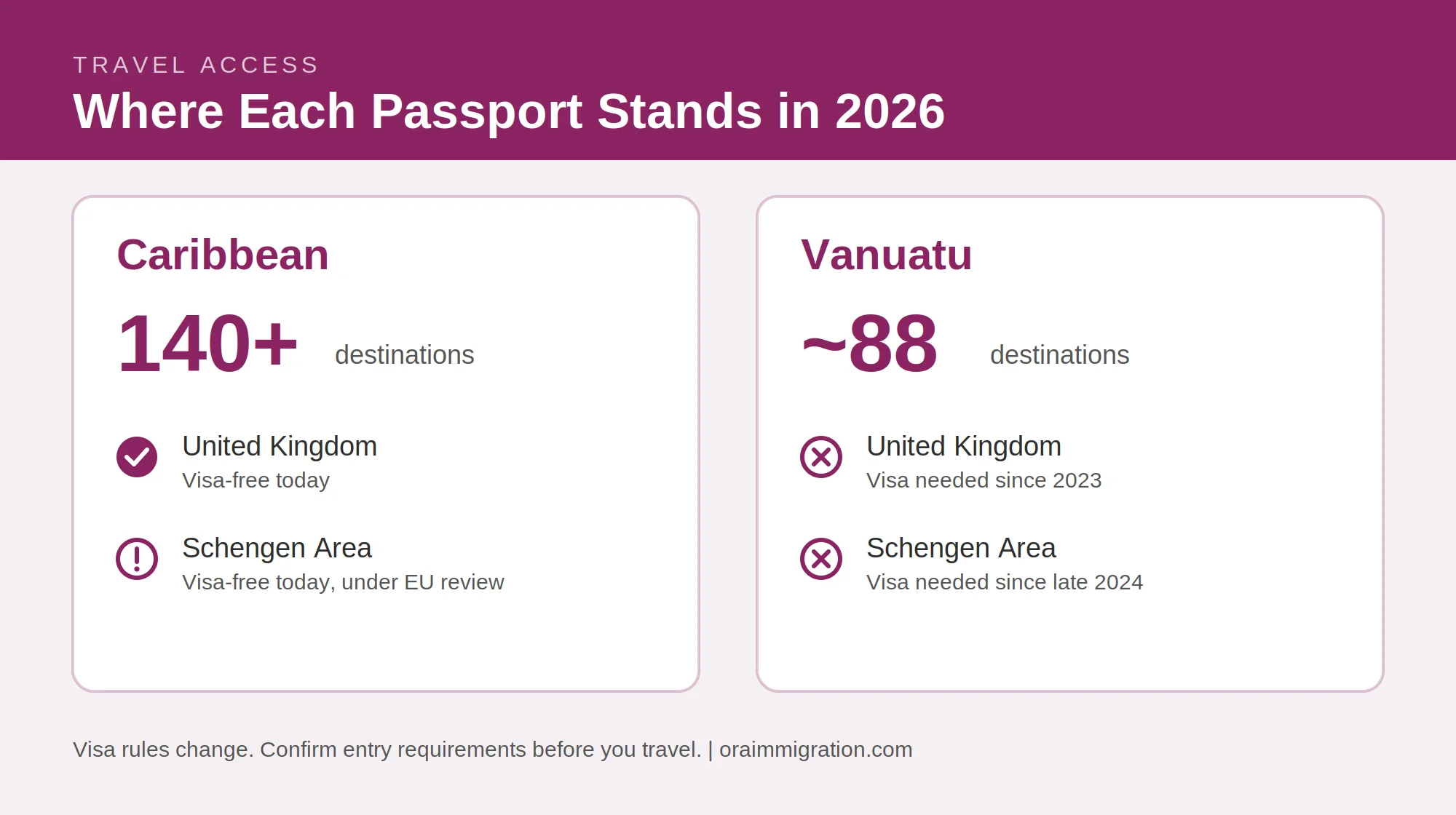
Caribbean passports open 140 or more destinations, including the UK and the Schengen Area. That’s the big draw. But the Schengen part is now conditional.
At the end of 2025, the EU changed its rules so that running a citizenship by investment program can, by itself, be grounds for suspending visa-free travel. According to Antigua and Barbuda’s government, the European Commission has asked the five Caribbean countries to wind their programs down by June 2028. Any suspension would still need a separate EU decision, and none has been announced. The Commission’s next report is due in December 2026. The US has also tightened some visa rules for Caribbean CBI countries this year, so check your destination against your specific passport.
Vanuatu has already been through this. The UK ended visa-free travel in 2023, and the EU ended it for good in late 2024. What’s left is around 88 destinations on the Henley Passport Index, including Singapore and Hong Kong.
So today, a Caribbean passport gets you further. But if Europe is the main reason you want a second passport, don’t build your plan on any CBI passport. Treat Schengen access as a bonus that could change.
Speed and Process
In our experience, both take roughly four to eight months from first call to passport in hand. Vanuatu’s government quotes 30 to 60 days for processing, but the paperwork around it, like attestation and due diligence questions, takes the rest.
The process differs in a few places. Vanuatu requires biometrics from everyone on the application, whatever their age, and its Dubai office takes them. Caribbean requirements vary by country. St Kitts & Nevis, for one, requires biometrics as of 2026.
What Drives the Cost
The two drivers are the same in both programs: how many people are on the application, and which passport you hold now. A bigger family costs more. Adding someone after approval costs more again, so include everyone you might want covered at the start. Some nationalities need heavier checks, which can change the fees or even rule a program out.
We won’t print figures here, since they move. The Caribbean gives you five programs with different structures to shop between, while Vanuatu is a single program. Ask us for current numbers for your family and your passport.
Who Should Choose Which?
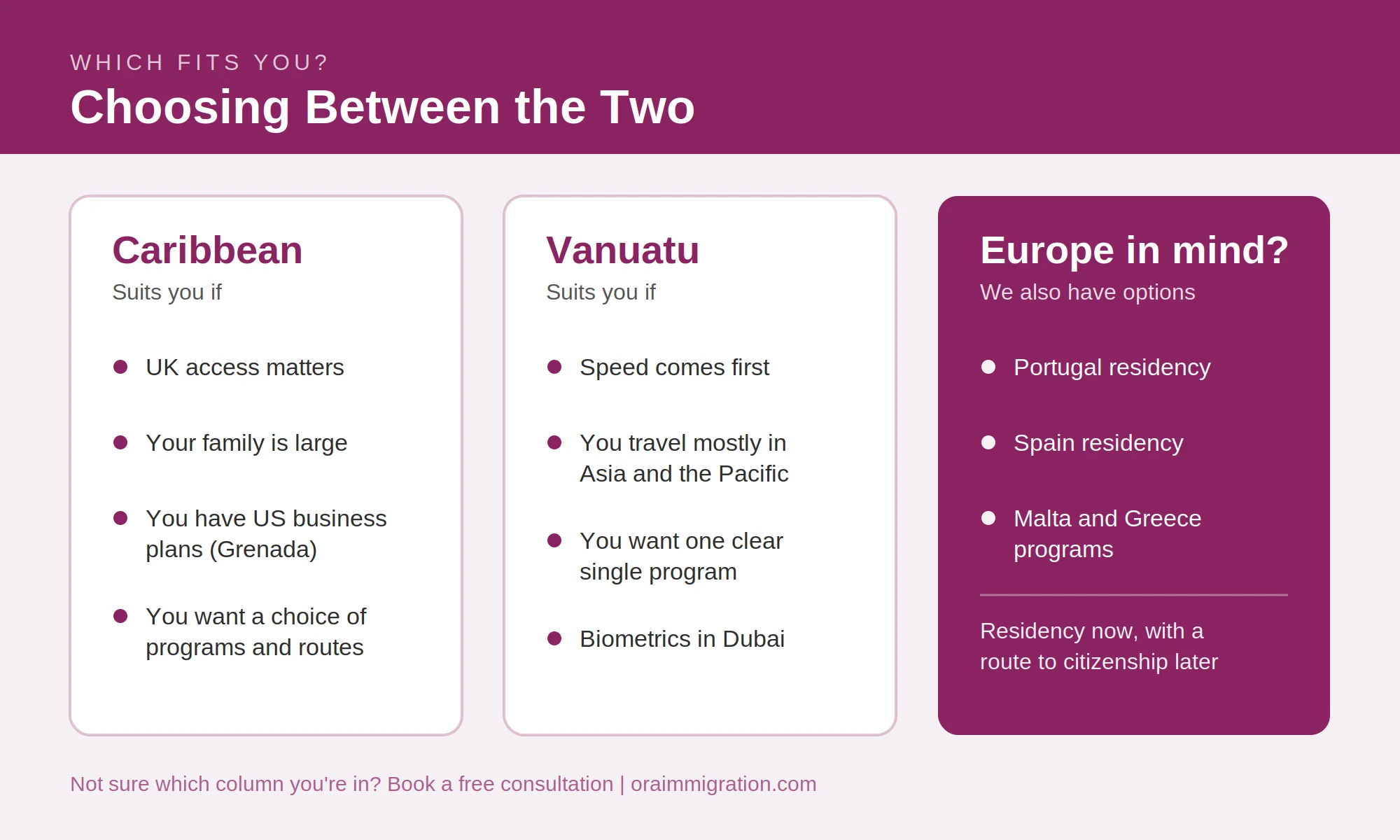
The Caribbean tends to suit you if:
- Travel access today matters, especially the UK
- You have a large family, or US business plans (Grenada has a path to the US E-2 Investor Visa)
- You’d like a choice of programs and routes, including real estate or a bond option
- You can live with the chance that Schengen access changes
Vanuatu tends to suit you if:
- Speed and simplicity come first
- Most of your travel and business is in Asia and the Pacific
- You want one clear program, with biometrics done in Dubai
- Europe isn’t why you’re doing this
There’s a third option too. If your real goal is living or studying in Europe, a CBI passport isn’t the right tool, but we also help with residency in Portugal, Spain, Malta and Greece. A residency permit, with a route to citizenship later, rests on firmer ground. Our European residency guide covers each one. And if your home country doesn’t allow dual nationality, sort that out before anything else.
Common Mistakes
Planning around Schengen access is the big one. It exists for Caribbean passports today, but it isn’t guaranteed.
Assuming your home country allows dual citizenship catches people out too. Check first, because losing your original citizenship is a steep price.
Choosing on speed alone is another trap. Both programs take months, and a few weeks’ difference rarely matters more than where you’ll actually use the passport.
Then there’s budgeting for one person. Families add up fast, and adding people late costs more.
Unlicensed agents cause real trouble. Both programs require a designated or authorized agent.
And attestation takes longer than people expect from the UAE and GCC side. Start it early.
Important DisclaimerThe information on this page is provided for general informational purposes only and should not be considered legal or immigration advice. Immigration laws, eligibility requirements, fees, and processing times may change without notice. Applicants should always verify the latest requirements with the relevant authorities or seek professional guidance before making any immigration decisions.
No. Citizenship is permanent and comes with a passport. A residence permit is a right to live somewhere, and it can lapse.
It can be. It helps if your residence depends on a job or sponsor, if your current passport makes travel hard, or if you simply want a fallback plan. It helps less if your current passport already covers your travel and you don’t need a backup. Think of it as a tool, and it only pays off if you have a job for it to do.
es. Descent from a parent or grandparent, marriage, and naturalization after years of residence all work without a large investment. They take longer, and they depend on your family or your circumstances. Investment is the fast route, not the only one.
It ranks the world’s passports by how many destinations their holders can enter without a visa in advance. It’s a handy yardstick, but it’s a count, not a quality score. Which destinations are on your list matters more than the total.
No. Visa-free access, where it exists, covers short visits only, usually up to 90 days in any 180 in the Schengen Area. Vanuatu passports need a visa even for those. For the right to live and work there, you’d need a residence permit, which we cover in our European residency guide.
Yes. Visa-free entry depends on other governments, and they can change their rules at any time. Vanuatu passports lost it for the UK in 2023 and for the EU in late 2024. Caribbean passports are under EU review now. Plan around the places you actually travel to, and check the rules before every trip.
Not so far. According to Antigua and Barbuda’s government, the EU has asked the five countries to phase theirs out by June 2028. The countries have defended their programs, and no one has shut one down. That could change, so ask us what’s current before you commit.
In principle, yes, but most people pick one. Each has its own due diligence and its own costs. Talk to us before you decide.
Neither wins for everyone. The Caribbean offers wider travel access today and more choice between programs. Vanuatu is one quick program that suits Asia and the Pacific. Your travel plans, family and appetite for risk decide it.
Close enough for most purposes. Dual citizenship and dual nationality both describe holding two countries’ citizenship. A second passport is the travel document that comes with the second citizenship. Legal systems sometimes treat nationality and citizenship as separate ideas, but for these programs you can treat them as one.
Still deciding between the Caribbean and Vanuatu? Reach out for a free consultation and we’ll compare both against your passport, your family and your travel plans.